Pursuing the Commercialization of Solar Hydrogen
A User Interview Celebrating 70 Years of Shimadzu Gas Chromatographs
"Solar hydrogen" is produced by using sunlight to split water into hydrogen and oxygen. Hydrogen has attracted growing attention as an energy source because it does not generate carbon dioxide when used, and research continues to advance in support of realizing a sustainable energy society. The technology that makes solar hydrogen production possible is the "photocatalyst", a material that uses light energy to drive chemical reactions. By harnessing sunlight to split water into hydrogen and oxygen, solar energy can be converted directly into hydrogen.
Central to this research is gas chromatography (GC), an analytical method that separates and measures the components of a mixture. In this scenario, it is used to analyze the hydrogen and oxygen generated during the reaction. In this interview, we spoke with Professor Domen of Shinshu University, a researcher who has devoted many years to advancing the practical application of solar hydrogen production via photocatalysis. He discusses the origins of his research, his use of GC in day-to-day work, and his vision for the future of solar hydrogen.
-
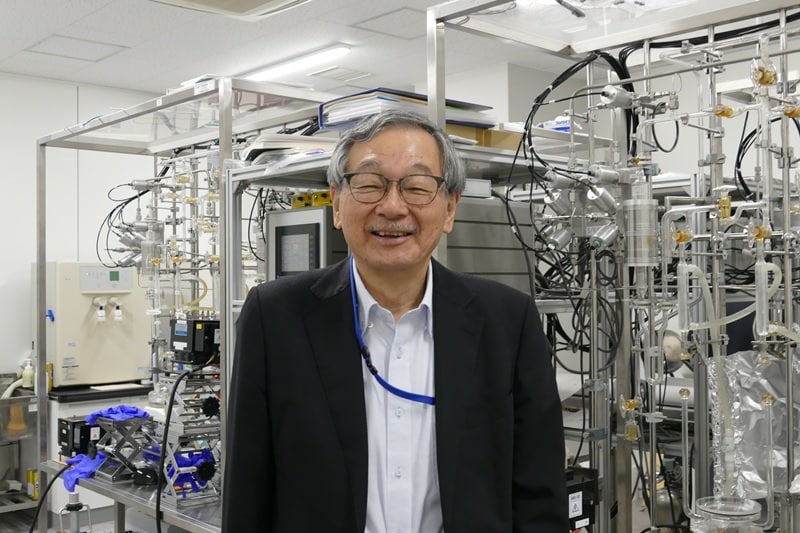
Prof. Kazunari Domen
Distinguished University Professor
Institute for Aqua Regeneration (ARG)
Shinshu University
University Professor, The University of Tokyo
"Tackling difficult research challenges is what I personally enjoy most, so I believe the joy of the research itself is my greatest motivation."
Interview Topics
1. The Origins of the Research and Its Social Significance
── Please tell us about the driving force behind your pursuit of such an ambitious goal as "the commercialization of solar hydrogen," and what this research means to you personally.
My journey began in 1979, when I entered a doctoral program and was drawn—out of pure curiosity—to the idea that fine-particle photocatalysts might be used to split water into hydrogen and oxygen using solar energy. Initially, I worked solely with UV-responsive photocatalysts, but my interest gradually shifted to whether visible light—which constitutes the majority of sunlight—could be used to convert light energy into chemical energy, just as natural photosynthesis does. Around 2005–2006, we succeeded in developing photocatalysts capable of splitting water under visible light. During that same period, climate change and energy security were emerging as major global concerns, and interest was growing in the potential of photocatalysts to enable sustainable, carbon-free hydrogen production. Making photocatalytic water splitting practical requires achieving high solar energy conversion efficiency using visible light. Although photocatalysts capable of splitting water across a broad range of the visible spectrum have been developed, improving their efficiency remains a persistent challenge. Once more efficient photocatalysts are realized, we believe it will be possible to build a system capable of producing large quantities of low-cost green hydrogen. This research began purely as a personal interest, but given its potential for significant societal contribution, I feel a certain sense of responsibility as well. That said, taking on difficult research challenges is what I enjoy most, and the excitement of research itself remains my greatest motivation.
2. The Role of Analytical Technology in Research
── In evaluating the water-splitting reaction driven by photocatalysts—specifically, the generation of hydrogen and oxygen—why is analysis by gas chromatography (GC) indispensable?
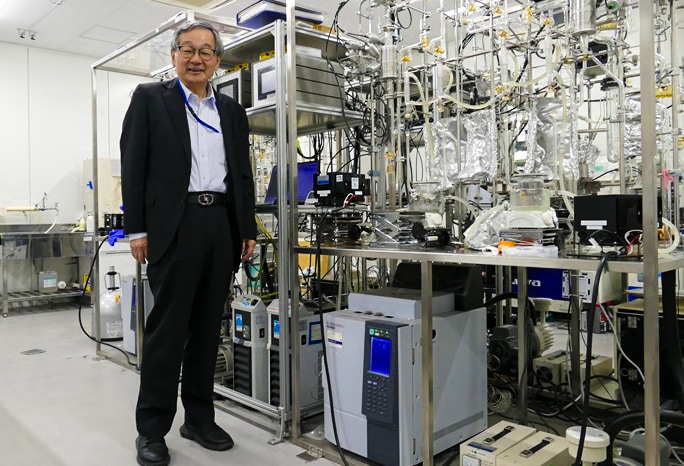
Professor Domen with the GC-2014
-
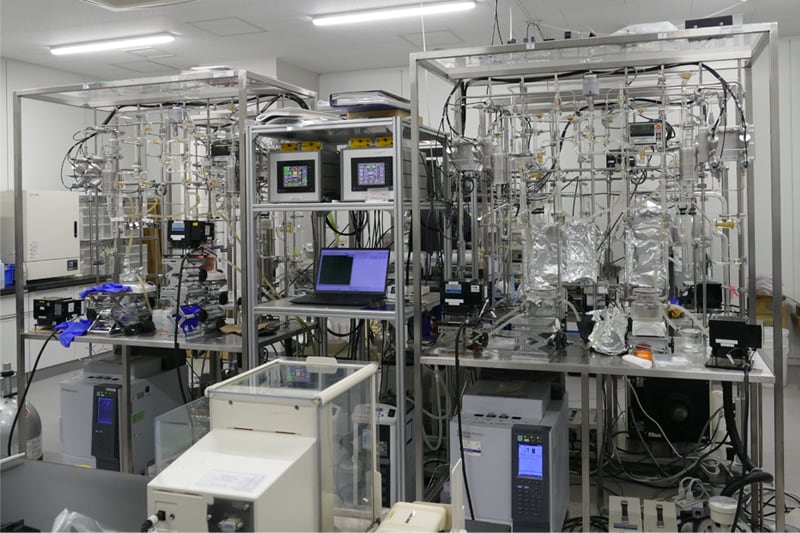
Analytical instruments are indispensable in the development of water-splitting photocatalysts, and among these, gas chromatography plays the most central role. To put it plainly, photocatalyst research can be conducted with little more than water, the photocatalyst material, a light source, and a reaction apparatus equipped with a GC—making it a relatively inexpensive field of research. However, confirming that water has actually been split requires verifying that hydrogen and oxygen are produced in a 2:1 ratio, with particular focus on ensuring that oxygen has been generated in the correct stoichiometric proportion. A GC is the only instrument capable of doing this. Without a GC, analyzing the reaction products would require an enormous amount of effort, and developing new photocatalysts with still-low activity would be virtually impossible. Of course, other advanced analytical techniques for characterizing photocatalyst structure, composition, and surface properties are also important, but GC-based activity evaluation is the first and most fundamental step in photocatalyst development. It would not be an overstatement to say that without GC, the diverse range of photocatalysts we have today would never have been developed.
3. Trust and Confidence in Shimadzu GC
── Having used Shimadzu GC and other analytical instruments for many years, what are your impressions—from the perspective of an expert—regarding operability, data reliability, and instrument robustness?
During my graduate studies at the University of Tokyo, I used a handmade GC built by a senior member of our laboratory. I first began using a commercially available GC after joining the Research Laboratory for Resources Utilization at Tokyo Institute of Technology (as it was then known) as a research associate. That GC was, of course, a Shimadzu instrument. The molecules we needed to analyze in water-splitting photocatalyst research are essentially hydrogen, oxygen, and nitrogen (for air leak checks), with occasional analyses of CO and CO₂ (requiring a column change). For these purposes, a basic GC using Ar as the carrier gas and equipped with a Thermal Conductivity Detector (TCD)—without a temperature programming function—was entirely sufficient, and we relied on the Shimadzu GC-8A for many years. That model was reasonably priced, easy for even a beginner to use right away, and virtually trouble-free as long as column baking was performed—a perfect fit in every way. I personally find it very regrettable that this model has been discontinued. At Tokyo Tech, I was also involved in research beyond photocatalysis, conducting studies using GC coupled with an infrared spectrometer to investigate correlations between surface-adsorbed species and reaction products as well as the types and activities of various organic-compound catalysts. For those applications, I used higher-end GC instruments equipped with both a Flame Ionization Detector (FID) and temperature programming capability—and again, all of them were Shimadzu GCs. Over time, the introduction of Chromatopac followed by PC-based sampling and automated data analysis made research considerably more efficient. However, this also introduced some pitfalls: results reported to five or six significant figures became commonplace, and in cases where low-activity catalysts produced peaks that automatic peak detection software overlooked, the activity would be incorrectly recorded as zero. For our work, even very low activity can represent critically important data in the early stages of photocatalyst development, so careful attention to these points is essential.
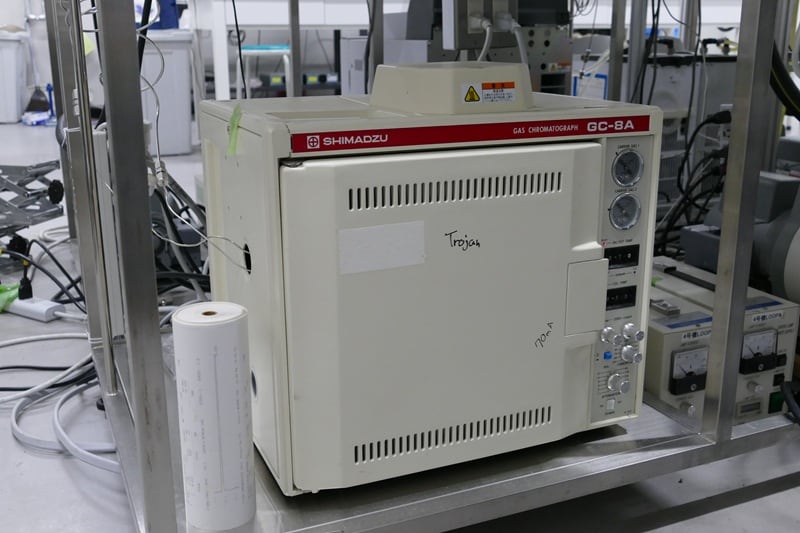
GC-8A
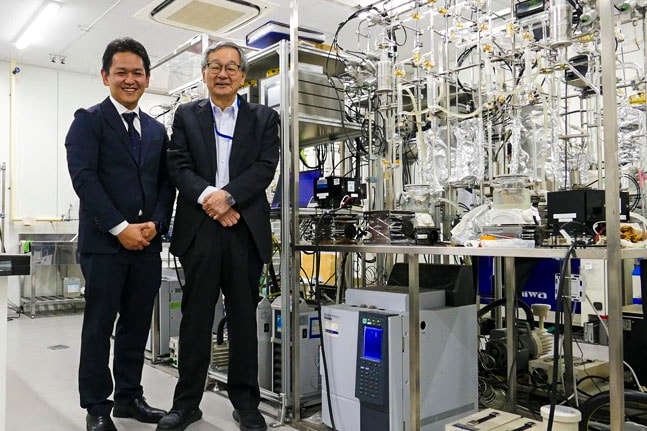
Shimadzu Corporation GC Product Manager Takechi (left) and Professor Domen (right)
4. Seventy Years of Progress and Technological Evolution
── Shimadzu GC celebrates its 70th anniversary this year. Looking back over your research career, how do you feel that advances in analytical technology and instrumentation have expanded—or changed—the speed and scope of your research?
I entered research life in September 1976, joining Professor Kenji Tamaru's laboratory at the University of Tokyo for my undergraduate thesis. Throughout my 50-year career, excluding three and a half years when I worked with ultra-high vacuum equipment, GC has consistently been a partner in my research, providing the data I needed. It would not be an overstatement to say that my research could not have advanced without GC data. In terms of data quality, GC provides highly reliable quantitative results—though water-splitting experiments do require a degree of care and technique when sampling from an atmosphere containing water vapor. While GC has become more efficient and easier to use over the years, the fundamental quality of the data it provides has not changed. GC data remains essential to advancing research. Among other analytical and measurement technologies, some have undergone remarkable advances during this period—synchrotron radiation-based analysis being one notable example. STM and electron microscopy have also advanced remarkably.
These advances have undoubtedly given us access to information that was previously unavailable or invisible, allowing us to understand the materials we work with far better than before. This has proven particularly valuable for analyzing reaction mechanisms in biological systems and detecting pollutants in the atmosphere or in seawater. Looking back at my own field, however, I have some reservations about whether advances in analytical technology have directly accelerated the pace of research and development. It is true that electron microscopy occasionally reveals a structure quite different from what we had imagined, but refining those structural insights rarely leads to an immediate breakthrough. The essential requirement is to absorb such findings and then think carefully and deeply once more. It may be more accurate to say that nature is far more profound than we can imagine.
The same might be said of the rapidly advancing field of AI. When you consult AI, it offers various research directions, but from the perspective of a specialist, the ideas it generates are often ones that have already been considered. The day may come when AI produces ideas that researchers could never have imagined on their own, but at present, in fields such as materials development—as opposed to mathematics and certain other disciplines—that has yet to happen. Of course, AI may identify aspects that a less diligent researcher might have overlooked. What I wish to emphasize is that, at the current moment, what remains fundamentally important is for researchers to deeply understand the information generated by advanced analytical instruments and AI, and then engage in careful, independent thinking to chart new directions.
5. A Vision for the Future and a Message to the Next Generation
── What are the "next challenges" on the path to deploying solar hydrogen in society, and what are your expectations for the next generation of researchers and for partner companies such as Shimadzu Corporation?
There are two key priorities for future research and development toward the social implementation of "solar hydrogen." The first is to develop, as quickly as possible, a photocatalyst with a solar-to-hydrogen (STH) energy conversion efficiency of at least 5%. We already have a clear target photocatalyst in mind, and the challenge for us is how to systematically improve it. The second priority is determining how to deploy the reaction system cost-effectively, with sufficient durability, and at a large scale. If this reaction system is conceived as a kind of chemical plant—analogous, for example, to solar cells paired with water electrolysis—the cost of the resulting hydrogen will never undercut that of hydrogen produced from fossil resources. The hydrogen production system we envision, therefore, is not a conventional chemical plant, but something more akin to oil or gas fields that spread out as two-dimensional expanses across the land. This concept has not been seriously attempted before and therefore requires a clear shift in thinking. We are currently pursuing new ideas that can help realize this type of system.
For the next generation of researchers, I hope they will come to understand the importance of research fields like ours and be drawn to enter them with genuine interest. Global warming and energy challenges are not problems that can be solved overnight; however, if left unaddressed, they will clearly reach a point of no return as global-scale problems. These issues cannot be resolved by academic researchers alone; governments and industry must respond together to address them. Nor can any single technology solve everything on its own. For partner companies such as Shimadzu Corporation, it would therefore be of tremendous value to provide researchers with timely and accurate support, delivering the knowledge and information they need.
AICS: Aqua Innovation Center, Shinshu University
Shinshu University