


Brevis GC-2050 - Applications
Gas Chromatograph

Most of the documents on the LITERATURE is available in PDF format. You will need Adobe Acrobat Reader to open and read PDF documents. If you do not already have Acrobat Reader, you can download it free at the Adobe's Website. Click the GET ADOBE READER icon on the left to download a free copy of Adobe Acrobat Reader.
Pharmaceutical
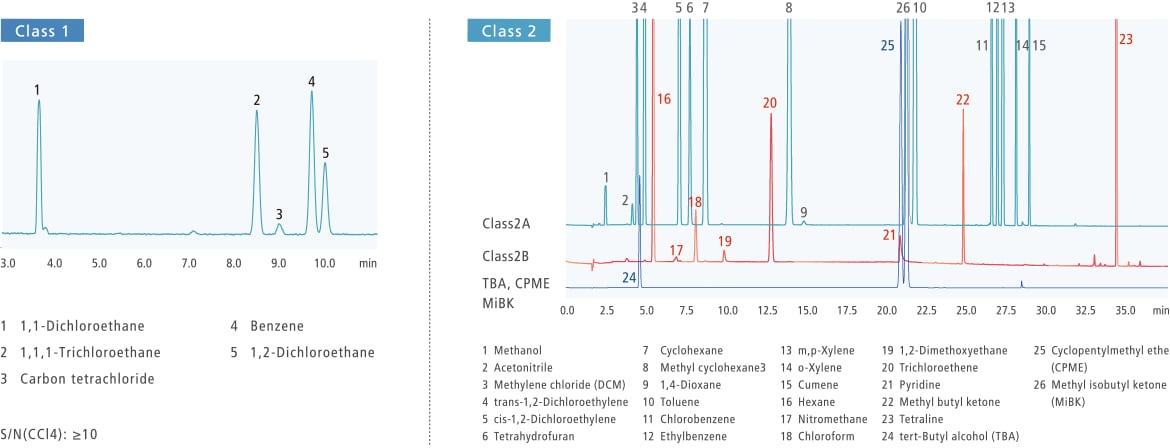
Residual solvent analysis in pharmaceuticals according to USP <467> using H2 carrier gas
Shown here are the results from an analysis of a standard solution for operating method A (water-soluble samples). In the analysis of carbon tetrachloride, which requires sensitivity confirmation, against residual solvents in Class 1, a good S/N ratio was achieved. Furthermore, excellent separation analysis is possible for Methyl Isobutyl Ketone (MIBK), which has been added to the Class 2 list.
GX (Green Transformation)
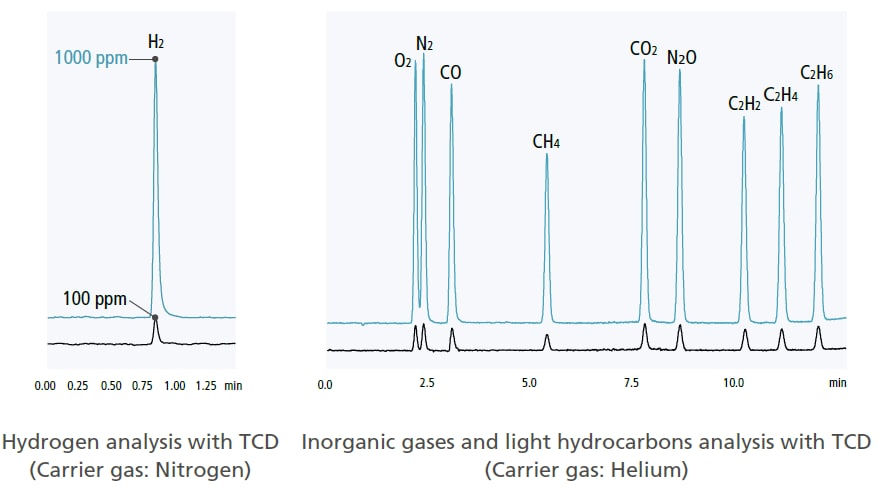
Analysis of Inorganic Gases and Light Hydrocarbons Using GI-30 Auto Gas Injector
-
The redesigned Thermal Conductivity Detector (TCD) and Shimadzu's unique Barrier Discharge Ionization Detector (BID) allow the analysis of compounds from trace to high concentrations (sub-ppm to percentage levels). Combined with the new GI-30 auto gas injector, they support various gas analysis needs. The GI-30's features to prevent adsorption and maintain temperature ensure high accuracy. The chromatogram below shows results using the GI-30 and TCD detector on the Brevis.
-
-
-
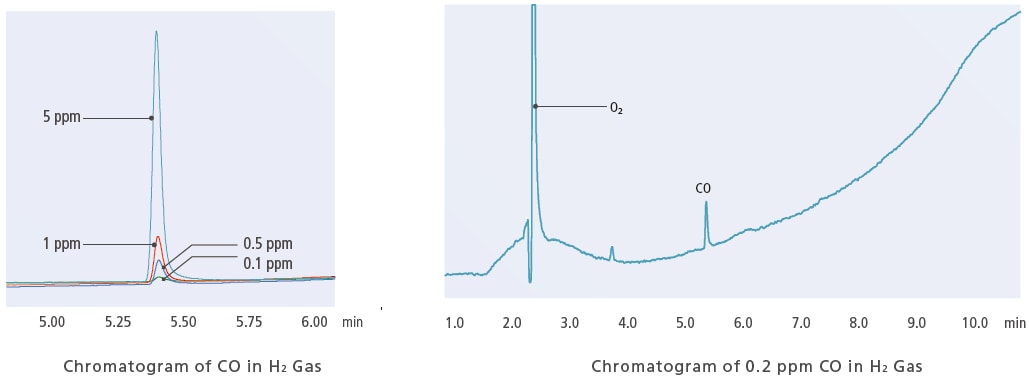
Analysis of Trace Carbon Monoxide (CO) in Hydrogen Fuel Using Jetanizer The Jetanizer is an FID nozzle methanizer that can convert CO and CO2 to CH4. Using the Brevis GC-2050 and the Jetanizer, Carbon Monoxide (CO), an impurity in hydrogen fuels, can be analyzed and detected with high sensitivity at 0.2 ppm, the concentration permitted in ISO 14687-2019.
-
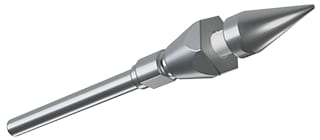
- Appearance of the Jetanizer
Chemicals, Fragrances, and Food Products
Simultaneous MS and FID Analysis of Cypress Oil Using a Detector Splitting System
-
The detector splitting system allows you to obtain data from multiple detectors simultaneously in a single measurement. In this example of analyzing cypress oil, we monitored key components using an FID, which provides excellent linearity, and identified other unknown components with an MS.
-
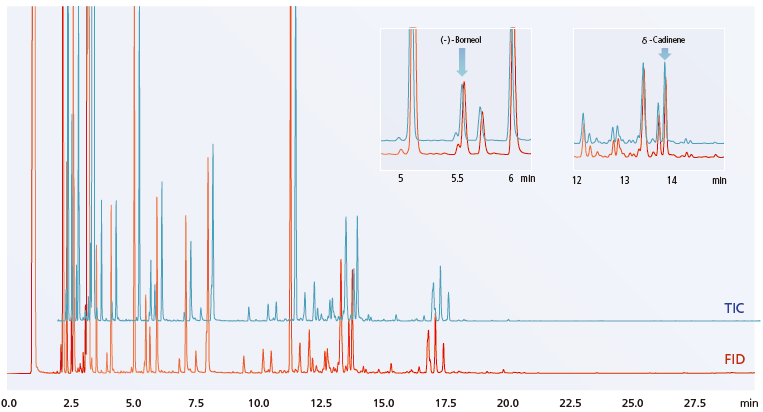
- Fig. 6 Cypress Oil FID and TIC Chromatograms
Environment
-
Fast analysis of Total Petroleum Hydrocarbons (TPH)
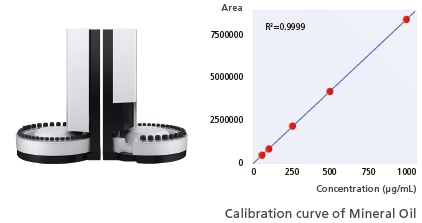
using H2 carrier gas with dual injectorsDespite its compact body, the Brevis GC-2050 is capable of simultaneous dual-line analysis. In this example, dual-line, high-speed TPH analysis was performed to maximize analytical throughput with a single GC.
-
-
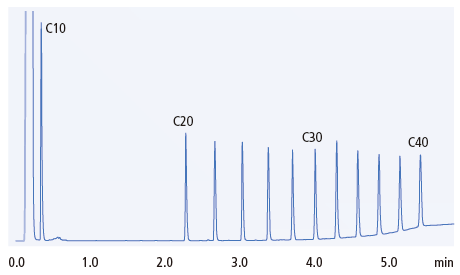
- Chromatogram of n-alkane mixture samples
-
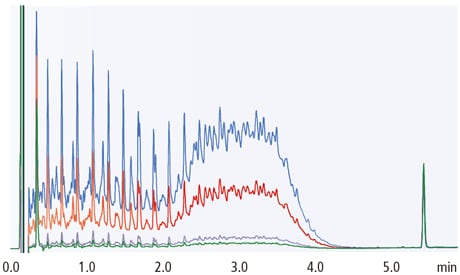
- Overlaid chromatograms of QC standard solutions