

Shim-pack SR-C30 - Features
HPLC Column
High Isomer Separation Capability
The long C30 chains of the SR-C30 provide hydrophobic retention capacity and responsiveness to structure, enabling clear separation of isomer peaks that have insufficient resolution when run on C18 columns. That makes it the perfect column for analyzing isomers of retinoic acid or aldehydes regulated by U.S. Environmental Protection Agency (EPA) 8315A or the Japanese Offensive Odor Control Law.
Analyzing Retinoic Acid Isomers
-
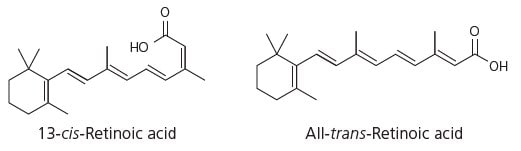
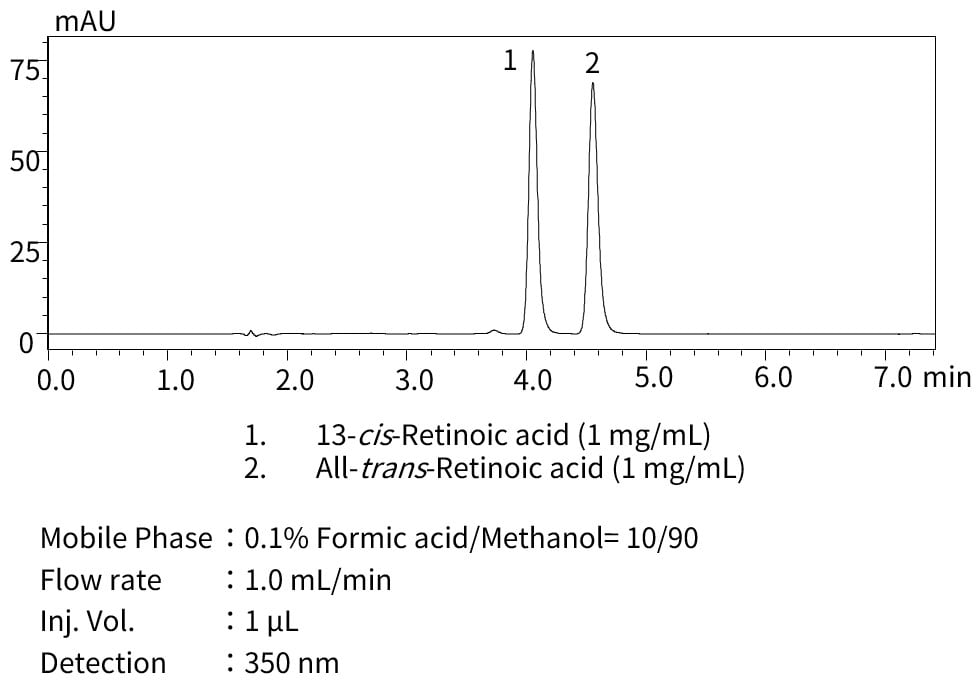
Although geometric isomers of retinoic acid, such as all-trans, 9-cis, and 13-cis, can be separated using a typical C18 column, sufficient resolution is not always achieved due to their similar hydrophobic and structural properties. Here, a baseline separation of all-trans and 13-cis-retinoic acid isomers using a Shim-pack SR-C30 column is shown.
-
Simultaneous Analysis of Six Aldehydes Specified in the Offensive Odor Control Law
-
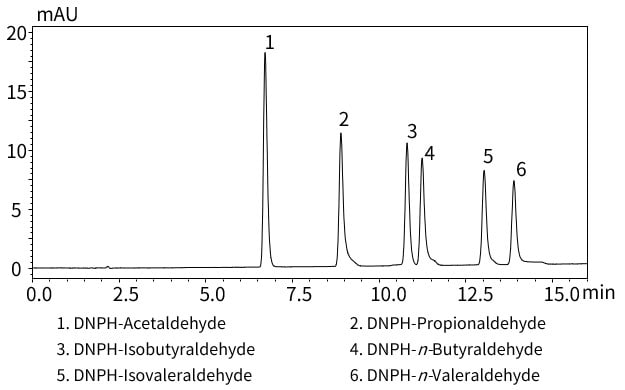
The Offensive Odor Control Law*1 specifically designates 22 substances as offensive odors. Here, results from an analysis of six DNPH-derivatized aldehydes specified as offensive odor substances (Table 1) are shown.
Table 1: Six Aldehydes Specified in the Offensive Odor Control Law
- Acetaldehyde
- n-butyraldehyde
- n-valeraldehyde
- Propionaldehyde
- Isobutyraldehyde
- Isovaleraldehyde
- Ministry of the Environment Methods for Measuring Specific Offensive Odor Substances—Attached Table 4
(Described in only Japanese, April 1, 2026)
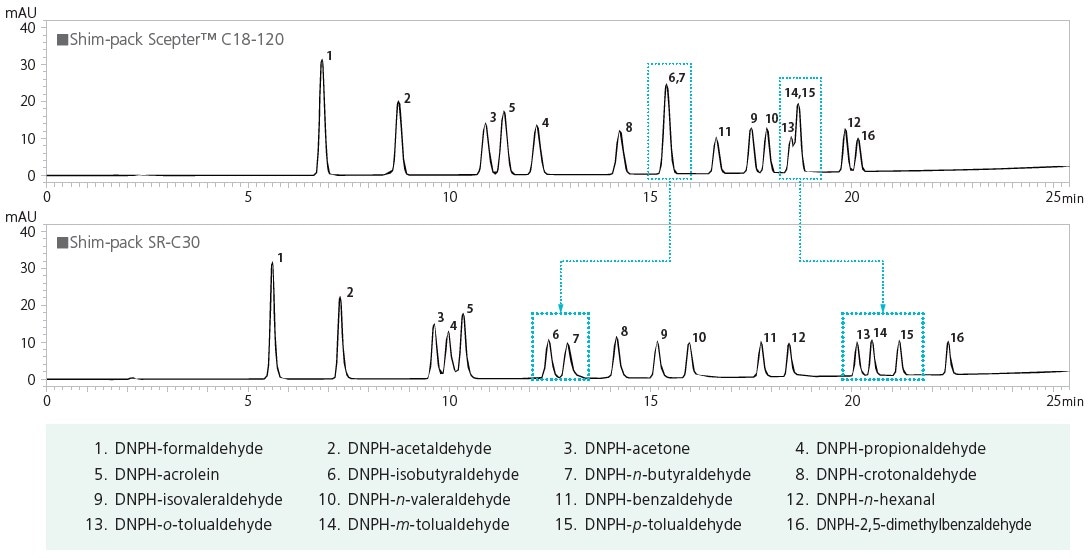
Simultaneous Analysis of 16 Components Including 15 Aldehydes Specified by the EPA
EPA 8315A*2 specifies analyzing 15 aldehyde components in indoor air (Table 2). Here, an example of the simultaneous analysis of 16 DNPH-derivatized components, including the 15 components listed in Table 2 and isobutyraldehyde, is shown.
Due to the multiple aldehyde isomers among the 16 components and the 6 components specified in the Offensive Odor Control Law mentioned above, some of the components are difficult to separate using a typical C18 column. This example compares a typical C18 column and the Shim-pack SR-C30 for analysis of the 16 components, highlighting differences in resolution and elution order. Using the C30 column enabled separation of components that were not adequately separated using the C18 column.
Table 2: 15 Aldehyde Components Specified in EPA 8315A
- • Formaldehyde
• Propionaldehyde
• Acetone
• Crotonaldehyde - • Isovaleraldehyde
• n-hexanal
• m-Tolualdehyde
• 2,5-Dimethylbenzaldehyde - • Acetaldehyde
• Acrolein
• n-butyraldehyde
• n-valeraldehyde - • Benzaldehyde
• o-Tolualdehyde
• p-Tolualdehyde
*2) U.S. Environmental Protection Agency METHOD 8315A