


2.1. Ionization Unit
2.1.1. Overview of Ionization Methods
There are numerous ionization methods available; the most appropriate technique and the type of mass information obtained depend on the state of the sample. These methods are broadly classified into three categories based on the phase from which ions are generated: gas, liquid, and solid.
| Category | Ionization Method |
|---|---|
| Gas-phase Ionization | Electron Ionization (EI) |
| Chemical Ionization (CI) | |
| Atmospheric Pressure Chemical Ionization (APCI) | |
| Atmospheric Pressure Photoionization (APPI) | |
| Liquid-phase Ionization | Electrospray Ionization (ESI) |
| Solid-phase Ionization | Field Desorption (FD) |
| Fast Atom Bombardment (FAB) | |
| Matrix-Assisted Laser Desorption/Ionization (MALDI) |
Ionization methods are selected and utilized based on their compatibility with specific chromatographic interfaces and sample introduction techniques.
For instance, GC-MS primarily employs gas-phase ionization techniques such as EI and CI. In contrast, methods like FD, FAB, and MALDI are designed to directly introduce solid or other sample forms into the mass spectrometer's ion source without chromatographic separation.
The "harshness" of the ionization process is another critical factor. While EI, commonly used in GC-MS, is a "hard" ionization method that causes molecular fragmentation, most other techniques are classified as "soft" ionization methods that minimize fragmentation. Because soft ionization preserves the intact molecular structure during the ionization process, it allows for the acquisition of molecular weight information.
Currently, ESI and APCI are the most widely adopted soft ionization methods in LC-MS, generating ions from the liquid phase. Because these techniques perform ionization at atmospheric pressure, they are collectively referred to as Atmospheric Pressure Ionization (API). The following section provides a detailed overview of API.
2.1.2. Atmospheric Pressure Ionization (API)
The introduction of Atmospheric Pressure Ionization (API) has significantly advanced interface technology, achieving stable ion generation. As the name implies, API performs ionization at atmospheric pressure. This approach is highly effective for removing solvents before the ions enter the vacuum region, making it extremely powerful for online coupling with LC. Currently, two primary API techniques are widely utilized: Electrospray Ionization (ESI), which generates ions from the liquid phase, and Atmospheric Pressure Chemical Ionization (APCI), which generates ions from the gas phase.
2.1.3. Features of ESI
ESI is the most versatile ionization method currently employed in LC-MS. It is widely used for a broad range of analytes, including small to medium-sized organic molecules, pharmaceuticals, pesticides, metabolites, and biological macromolecules.
ESI offers the following features:
- Extremely soft ionization: Produces minimal fragment ions, facilitating the acquisition of mass information of the molecule.
- Broad applicability: Suitable for highly polar, non-volatile, and thermally labile compounds.
- Formation of multiply charged ions: Capable of generating ions with multiple charges per molecule.
Because ESI is an exceptionally soft ionization technique, it has become indispensable for analyzing non-volatile or thermally labile compounds, and is well-suited for medium- to high-polarity substances. Furthermore, the ability to form multiply charged ions is a major advantage. Even for extremely large macromolecules with masses that exceed the instrument's upper m/z limit, multiple charging effectively reduces their m/z values, bringing them within the detectable range. Leveraging this unique feature, ESI is extensively used for the analysis of high-molecular-weight biomolecules such as peptides, proteins, and nucleic acids.
2.1.4. Principle of ESI
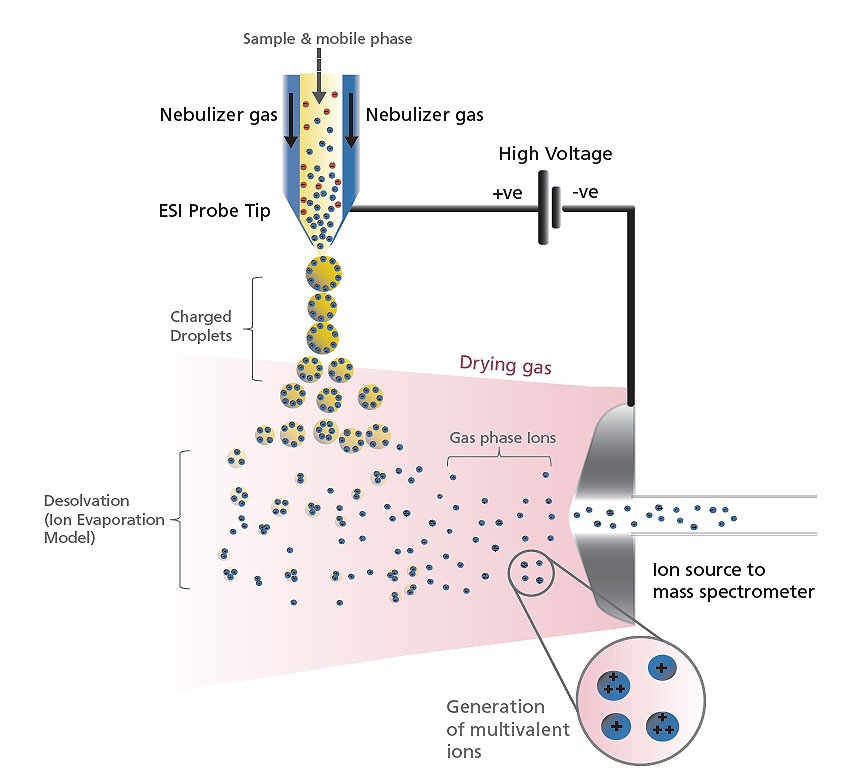
The solution containing the target compounds introduced from the LC passes through a capillary biased with a high voltage of several kilovolts (kV).
Ionization Process
- Taylor Cone Formation and Nebulization: In positive ion mode, the positive voltage applied to the capillary attracts negative charges in the solution toward the inner capillary wall. Consequently, positively charged species concentrate at the capillary tip, forming a conical shape known as a "Taylor cone." A fine mist of charged droplets is then sprayed from the tip of this cone with the assistance of a nebulizer gas.
- Droplet Fission (Coulombic Fission): As the solvent evaporates from the generated charged droplets, their charge density increases. This leads to intense electrostatic repulsion between like charges (Coulombic repulsion), causing the droplets to repeatedly split into even smaller ones.
- Gaseous Ion Generation: Through this continuous cycle of solvent evaporation and droplet fission, gaseous ions are ultimately liberated into the gas phase. The exact mechanisms of this ion liberation process are described by established theoretical models, such as the Ion Evaporation Model (IEM) and the Charged Residue Model (CRM).
2.1.5. Features of APCI
APCI utilizes an interface structure similar to ESI but operates on a fundamentally different ionization principle. It is particularly well-suited for analyzing low- to medium-polarity compounds, including lipophilic substances.
Key Features:
- Chemical ionization (ion-molecule reactions): Utilizes gas-phase chemical reactions to gently ionize analytes.
- Broad applicability: Suitable for low- to medium-polarity compounds, including lipophilic substances.
- Requirement of protic solvents: Relies on protic solvents (such as water or methanol) to facilitate the ionization process.
APCI can efficiently ionize compounds that are easily vaporized and possess sufficient polarity to accept a proton from reactant ions. Consequently, it is an effective technique for analytes that are difficult to ionize in the liquid phase, such as highly lipophilic compounds. Unlike ESI, APCI rarely produces multiply charged ions, even for high-molecular-weight compounds. Additionally, it is known to be less susceptible to interference from co-existing substances (matrix effects).
2.1.6. Principle of APCI
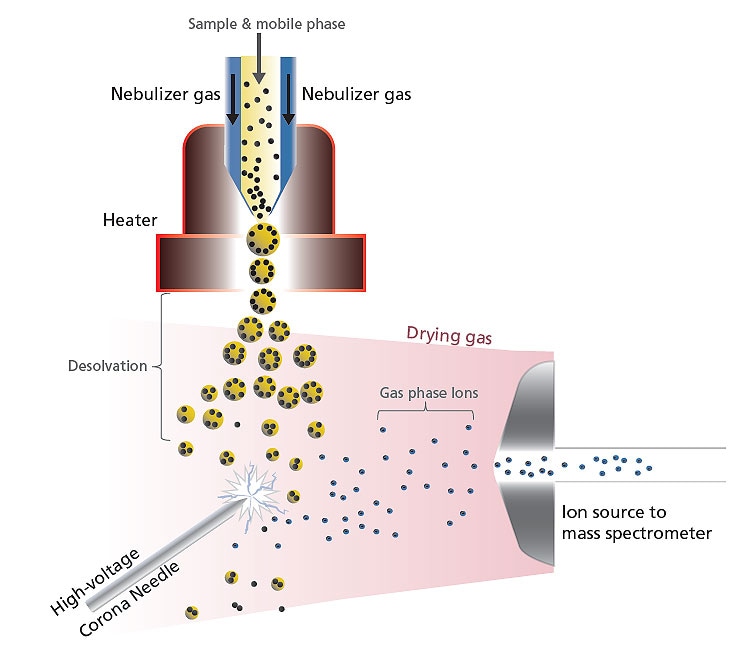
APCI is an ionization technique based on chemical ionization using gas-phase ion–molecule reactions. The sample is converted into gaseous ions through the following steps.
Ionization Process
- Nebulization and Vaporization: The mobile phase containing the analyte introduced from the LC is nebulized with nitrogen gas (nebulizer gas). The sprayed droplets are then heated and rapidly vaporized by a heater.
- Reactant Ion Generation: The vaporized mobile phase solvent (such as water or methanol) is ionized by a corona discharge, generating stable reactant ions (such as H3O+).
- Analyte Ionization (Proton Transfer): Along with the vaporized mobile phase, the analyte also vaporizes within the same region. Here, proton (hydrogen ion) transfer occurs between the analyte and the reactant ions. If the analyte has a higher proton affinity than the reactant ions, it accepts a proton to become ionized.
2.1.7. Compounds Easily Analyzed by Each Ionization Method

The figure illustrates the representative ionization methods and their application ranges. Electron Ionization (EI), commonly used in GC-MS, is suitable for small molecules with low to medium polarity. On the other hand, ESI, the primary method in LC-MS, can analyze a broad range of compounds across a wide range of molecular masses with medium to high polarity. Additionally, APCI is well-suited for small molecules with low to medium polarity.
One of the major differences between GC-MS and LC-MS is the pressure environment during ionization: vacuum versus atmospheric pressure. GC-MS separates vaporized analytes in the gas phase and ionized them under high vacuum, making it difficult to introduce the mobile phase directly as a liquid, as is done in LC. It is also unsuitable for non-volatile or thermally labile compounds. In contrast, LC-MS separates analytes in the liquid phase and ionizes them at atmospheric pressure in either the liquid or gas phase, allowing for the stable analysis of compounds that are difficult to measure by GC-MS.
As described above, LC-MS is capable of analyzing an extremely diverse range of compounds. By selecting the appropriate method between ESI and APCI, a wide array of organic compounds can be comprehensively covered.
2.1.8. Other Ionization Methods
DART (Direct Analysis in Real Time) Ion Source
DART is a type of ambient ionization technique capable of directly ionizing solid, liquid, or gas samples without requiring complex sample preparation. A major advantage of this method is its ability to rapidly analyze compounds across a wide range of polarities in their native state, eliminating the need to dissolve insoluble or poorly soluble samples.
DART performs ionization at atmospheric pressure by leveraging the interaction between excited-state atoms or molecules and atmospheric gases.
Matrix-Assisted Laser Desorption/Ionization (MALDI)
This method ionizes analytes by irradiating a dried mixture of the sample and a matrix (an ionization aid) with a UV laser. Selecting an appropriate matrix for the sample can improve ionization efficiency.
Ionization Process
- Excited Gas Generation: Helium gas introduced into the DART source is converted into a plasma by an electrical discharge. After charged particles are removed, the gas is released into the atmosphere as an excited-state neutral gas. If necessary, the gas is heated to facilitate sample vaporization (thermal desorption).
- Positive Ion Detection: The excited helium reacts with ambient water molecules to form protonated water clusters ([(H2O)n+1+H]+). These clusters then transfer protons to the analyte, generating positive ions.
- Negative Ion Detection: Electrons released into the atmosphere by the energy of the excited helium react with oxygen to form oxygen radical anions (O2ー・). These anions then react with the analyte to generate negative ions.
In this manner, DART ionization allows for the simultaneous generation of both positive and negative ions. Furthermore, because analytes are thermally desorbed into the gas phase for ionization, this technique is highly efficient for the rapid analysis of low-molecular-weight compounds.
Related Applications
Probe Electrospray Ionization (PESI)
PESI is a type of ambient ionization technique that enables direct analysis without the need for LC method development or sample preparation. This method replaces the conventional ESI capillary with a fine probe (needle). A minute amount of sample is captured on the tip of the probe, and ionization is performed at atmospheric pressure by applying a high voltage. Because it allows for simple and rapid measurements, PESI is highly effective for applications such as impurity monitoring, high-throughput screening of biological samples, and real-time tracking of chemical reactions in organic synthesis.
Related Information
Atmospheric Pressure Photoionization (APPI)
APPI is a soft ionization technique used in LC-MS. In this method, the sample solution is nebulized under heat, and the resulting vapor is irradiated with ultraviolet (UV) light to eject electrons from the molecules, initiating photoionization. This technique is primarily used to analyze low-polarity compounds that are difficult to ionize using ESI or APCI.
Matrix-Assisted Laser Desorption/Ionization (MALDI)
MALDI is an ionization method where a mixture of the analyte and a matrix (an ionization-assisting agent) is co-crystallized by drying, and then irradiated with a UV laser to desorb and ionize the analyte. Selecting the optimal matrix tailored to the specific properties of the sample is crucial for maximizing ionization efficiency.
Related Information