Properties of Supercritical Fluids
Supercritical Fluid Example: Properties and Uses
What is a Supercritical Fluid?
A supercritical fluid (SCF) is a substance that exhibits properties of both liquids and gases when subjected to temperature and pressure above its critical point. This makes SCFs highly useful in various industrial and scientific applications.
Key Properties of Supercritical Fluids
- High diffusivity (similar to gases)
- High density (like liquids)
- Low viscosity, allowing better penetration
- Due to these characteristics, it is also widely used in extraction processes.
Table 1: Physical Properties of Supercritical Fluids
| Diffusion Coeefficient (m2/s) | Density (g/cm3) | Viscosity (g/cm-s) | |
|---|---|---|---|
| Liquids | 10-6 | 1 | 10-2 |
| Supercritical Fluids | 10-3 | 0.2-0.8 | 10-3 |
| Gases | 10-1 | 10-3 | 10-4 |
Physical Properties of Supercritical Fluids
Substances can change their state between solid, liquid, and gas states depending on the temperature and pressure. Vaporization and sublimation are phenomena that occur when heat activates the thermal motion of solid or liquid molecules in a substance, to an extent that the molecules break free from the intermolecular forces keeping the substance in its current state. For example, solid CO2 (dry ice) in a sealed container sublimates to reach a supercritical state under high-temperature high-pressure conditions (Fig. 1).
- Supercritical state = When a substance exhibits both liquid and gas properties.
- Critical Point = The precise temperature and pressure at which this transition occurs (see Table 1).
Supercritical state is when substance have properties of both gas and liquid, and they are thus called as Supercritical Fluid. This point in phase diagram with corresponding conditions of temperature and pressure is called Critical Point (Table 1). Supercritical fluids have a higher coefficient of diffusion with lower density and viscosity than liquids. Consequently, higher diffusivity results in better distribution into the mobile phase and better separation, and lower viscosity makes SFC a faster method than HPLC.
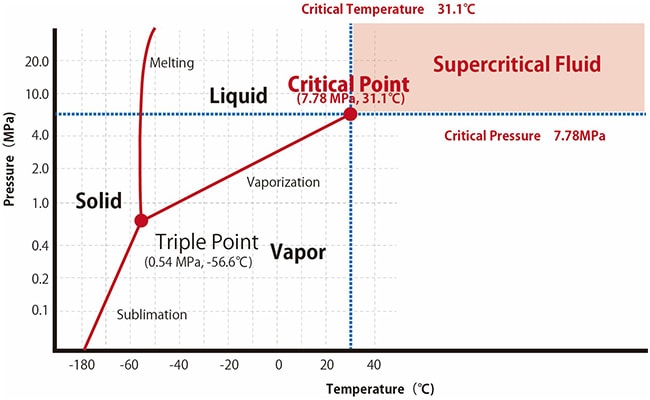
Fig.1 Phase Diagram for Carbon Dioxide
Supercritical Fluid Example: Carbon Dioxide (CO₂)
CO₂ is widely used as a supercritical fluid because it achieves a supercritical state under relatively low temperature and pressure conditions.
Critical pressures and critical temperatures for generating a variety of supercritical fluids are shown in Fig. 2. Water is commonly used for high-performance liquid chromatography, but due to its critical pressure of 22.1 MPa and critical temperature of 374 ℃, it cannot be easily kept under conditions necessary for transitioning to a supercritical state. In contrast, supercritical carbon dioxide has a critical pressure of 7.38 MPa and a critical temperature of 31.1 ℃, hence allowing transition to the supercritical state under relatively modest conditions.
For a detailed overview of Supercritical Fluid Chromatography (SFC), refer to our technical guide on SFC.
Supercritical carbon dioxide offers the following advantages.
- Handling
With critical points at 31.1 ℃ and 7.38 MPa, CO2 becomes a supercritical fluid under modest conditions. - Safety
CO2 is not flammable and has minimal risk of explosion even if used compressed. CO2 offers intrinsically low toxicity, when compared to other organic solvents. - Cost
CO2 is mainly sold as a liquid stored in high-pressure cylinder and in most cases can be acquired at a low cost. - Environmental Friendliness
Other organic solvents are incinerated for disposal, which emits large amounts of energy and CO2. However, liquified CO2 used in SFC is collected as a byproduct of fermentation processes or chemical plants. That means using liquified CO2 causes minimal environmental impact.
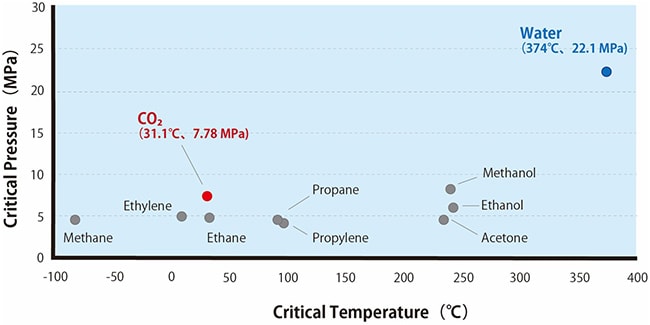
Fig. 2 Conditions for Generating Supercritical Fluids
For an in-depth look at chromatography techniques utilizing supercritical fluids, visit our HPLC /UHPLC/SFC product page.
Frequently Asked Questions
1. What makes a fluid supercritical?
A fluid becomes supercritical when temperature and pressure exceed its critical point, causing it to exhibit both liquid and gas properties.
2. Why is supercritical CO₂ preferred in extractions?
Supercritical CO₂ is non-toxic, environmentally friendly, and selectively extracts compounds without leaving harmful residues.