Tips for LC and LC/MS Analysis (Vial Selection): Components of a Vial
1. Components of a Vial
Vials used in LC and LC/MS analysis play an important role in ensuring the reliability of analytical results.
When selecting vials, it is necessary to pay attention to the interactions between (1) the compound to be analyzed, (2) the sample solvent, and (3) the wetted material of the vial.
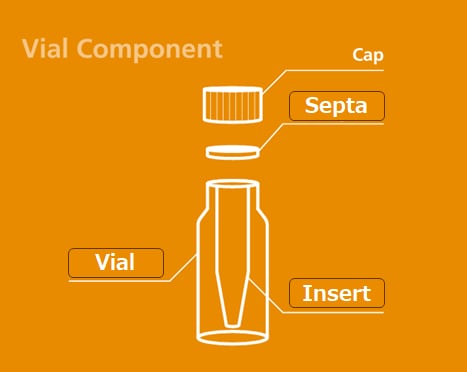
Common vial configurations and applications are listed below:
-
-
Less than 1.5 mL Analysis of small-volume samples Glass insert
Small volume glass vial
Small volume polypropylene vial1.5 mL Most generic 1.5 mL Glass vial
1.5 mL Polypropylene Vials4 mL For water analysis, pretreatment, etc. 4 mL Glass vial
4 mL Polypropylene Vials10 mL For pretreatment, etc. 10 mL Glass vial
The wetted parts are the vial or insert, and septum. Caps are often integrated with the septum and are designed so they do not come into direct contact with the sample.
2. Septum
The septum commonly consists of two layers: a cushioning layer and a film layer that forms the wetted surface in contact with the sample. The most versatile of these is the PTFE/silicon type, which combines the high sealing properties of silicon with the high chemical resistance of PTFE. On the other hand, PTFE film-only types offer excellent chemical resistance but poor sealing properties. The aluminum type also has excellent chemical resistance and is used in situations where silicone or PTFE cannot be used, but the disadvantage is that it is limited to one-time use due to poor sealing properties.
There are also septa designed with a pre-cut incision, known as a slit. This feature helps prevent negative pressure in the vial during sample aspiration, and prevents the septum from being forced into the bottle when the autosampler needle is inserted.
On Shimadzu's LC autosamplers, the needle tip design has been optimized and a small-volume bottle mode has been incorporated to counteract negative pressure, so slitless septa are used as standard.

| Material | Content |
|---|---|
| PTFE/Silicone | It has both the sealing property of silicone and the chemical resistance of PTFE. Most universally available septum. |
| PTFE | Excellent chemical resistance but poor sealing. |
| Aluminium | Used in analysis where Silicone or PTFE is not appropriate. |
3. Vial Bottles
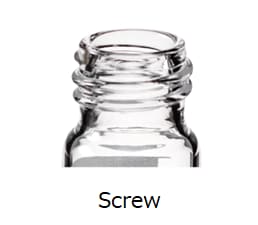
Vial necks come in two main shapes, and the cap must be chosen to match the neck style. The most commonly used type is the screw type, which can be opened and closed by hand, so it is used not only in LC but also in GC.
The snap type has poorer sealing and is not easy to decap, so its use has declined in recent years; however, it does offer the advantage of quick manual capping.
| Type | Sealability | Features |
|---|---|---|
| Screw | High | Most versatile and easy to put on and take off |
| Snap | Moderate | Capable of one-touch capping |
There are two types of vial colors: transparent and brown. The transparent type is often used because it allows you to visually check the condition of the sample.
The brown type is manufactured with materials that meet the UV transmittance reference values and is applied for the analysis of compounds that are easily degraded by light. However, due to their design that strikes a balance between visibility and light blocking, you cannot expect complete shading effects. For this reason, care must be taken not to disassemble it due to the working environment or the lighting in the autosampler.
Vial bottles are often made of glass and resin (mainly polypropylene). Among them, glass is widely favored in the market. In addition to excellent visibility and solvent resistance, glass vials are characterized by the fact that the glass surface is hydrophilic, so hydrophobic adsorption is less likely to occur. On the other hand, it is concerned that it induces ionic adsorption by silanols.
Polypropylene vials are characterized by the fact that they are easy to attract hydrophobic adsorption based on the material, but there is no concern about the leaching of metal ions. In particular, it is essential to apply it in ion chromatography.
Therefore, when selecting vial materials, it is crucial to consider interactions with the vial based on the physicochemical properties of analytes (such as solubility, hydrophobicity and dissociation constant).
The following interactions require attention:
- Leaching from vial materials
- Adsorption of target compounds onto vial materials
*Please refer to here for GC vials