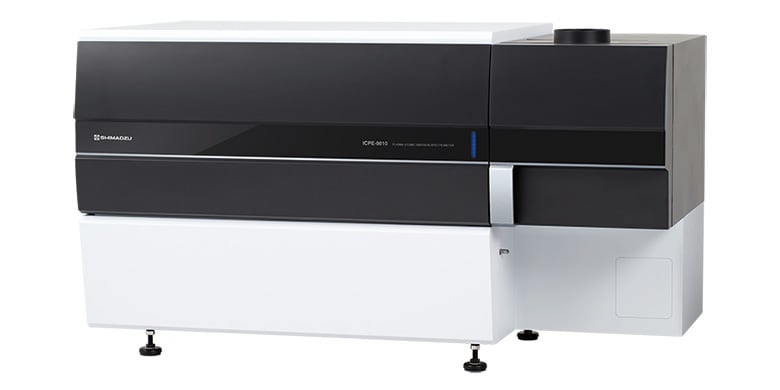
ICPE-9800 Series


Domestic wastewater or drainage from a particular business plant can only be discharged in public waters or reused as industrial water after being cleaned up in a sewage treatment facility. If such processed water is discharged into public waters, it is required to meet effluent standards. The increase of sewage sludge generated in the sewage treatment process, however, has become a problem. Thus, for the purposes of waste reduction and recycling, following incineration, sewage sludge is being re-used as cement material, civil engineering material, and fertilizer, etc. However, the reuse of sewage sludge, from the standpoints of environmental protection and potential health hazards, requires that its toxic heavy metal content is carefully examined. If sewage sludge is to be discarded in a landfill, etc., it is considered to be industrial waste and is therefore subject to regulation under the Japanese Waste Disposal and Public Cleansing Law (Waste Management Law). However, if it is to be reused, it is considered to be a valuable resource, and is subject to regulation under the Japanese Fertilizer Control Act and the Soil Contamination Countermeasures Law. To ensure that treated sewage water meets effluent standards, sewage sludge ash must be analyzed with high sensitivity to accurately quantify such elements as Pb and Cd, which may be present at trace levels up to high concentrations. Here, using the Shimadzu ICPE-9820 multi-type ICP atomic emission spectrometer, we conducted analysis of processed water from a sewage treatment plant, in addition to sewage sludge ash. The ICPE-9820, with its original plasma emission unit, permits high-throughput analysis of elements at trace- to high-concentration levels, with high sensitivity and high accuracy.
September 25, 2014 GMT