
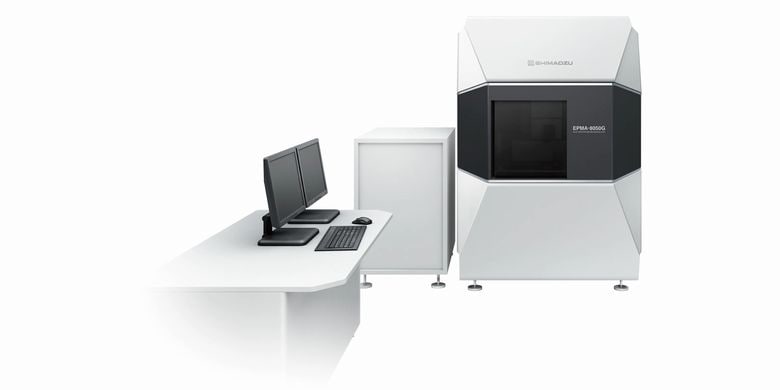
EPMA-8050G


In response to a heightened awareness of cleanliness, antimicrobial treatment has been applied not only to processed goods such as daily necessities, home electrical appliances, and textiles, but also to cosmetic and quasi-drug additives in recent years. Inorganic antimicrobial agents include a type which utilizes an antimicrobial ion chemical (antimicrobial activity: Ag+بCu2+, Zn2+) fixed by the surface or layered structure of a carrier such as zeolite, a phosphate compound, or a silicate compound, and a type which utilizes the photocatalytic reaction of titanium oxide (TiO2). Phosphate compounds have diverse types of crystal structures, for example, a layered structure or a glass structure. In phosphatetype antimicrobial agents, an antimicrobial ion such as the Ag+ ion, Zn2+ ion, or Cu2+ ion is supported by these structures. Inorganic phosphates with good biocompatibility such as hydroxyapatite also exist, and many antimicrobial agents using this compound have also been commercialized. This article introduces an example of an analysis of an antimicrobial gel and an antimicrobial filter using the Shimadzu EPMA-8050G EPMA™ electron probe microanalyzer.
October 27, 2020 GMT