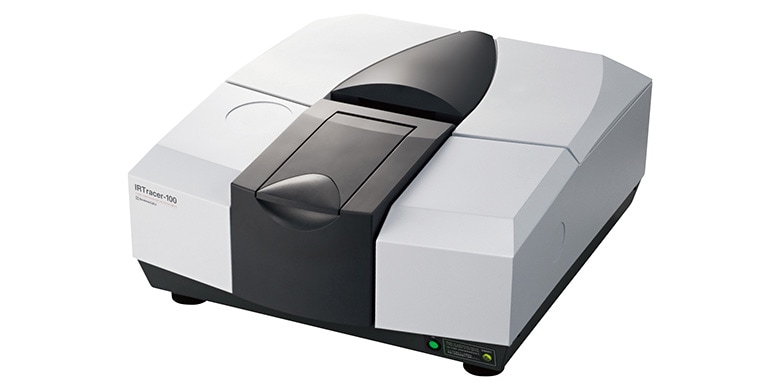
IRTracer-100


Spectrophotometric Analysis
Proteins have local three-dimensional structures that are called secondary structures such as α-helices, β-sheets, β-turns, and random coils. These structures are created by the hydrogen bonding of C=O groups and N-H groups of peptide bonds within or in between polypeptide chains. The infrared absorption related to such secondary structures appears as a single broad peak at about 1650 cm-1 due to the overlapping of multiple absorption bands. This broad peak is referred to as the "amide I band" and is caused by the stretching vibrations of C=O groups in peptide bonds. By analyzing the amide I band, we can obtain information about the secondary structure of proteins. A method for determining the individual peaks of overlapping absorption bands is curve fitting (peak splitting). Curve fitting expresses the waveform of each absorption band as a calculated spectrum using approximate curves such as Lorentzian or Gaussian curves and optimizes the peak information (position, intensity, and full width at half maximum) of the approximate curves to minimize the difference between the actually measured spectrum and the calculated spectrum. This article introduces an example analysis of the secondary structure of bovine serum albumin (BSA) using curve fitting.
January 13, 2019 GMT