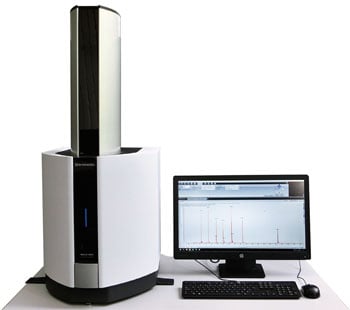
MALDI-8020


Matrix-Assisted Laser Desorption/Ionization Time-of- flight Mass Spectrometry (MALDI-TOF MS) facilitates a simple and quick analysis to obtain molecular weight information on diverse types of samples from small to macromolecules. Thus, there is a wide application range for MALDI-TOF MS instruments in R&D and quality control of synthetics and biological molecules. In conventional MALDI, the sample is co-crystallized with a matrix. For different analyte classes various matrices are available to support an efficient desorption and ionization process. Here, we show a slightly modified method that goes without solvation step and therefore is even quicker compared to conventional MALDI. The matrix is replaced with an etched silver surface and the name of the technique is referred to as Surface-Assisted Laser Desorption/Ionization (SALDI)-TOF MS although the instrument is still a MALDI-TOF. In addition to a decreased sample preparation time, further analyte classes can be obtained with this method. As an example of complex lipid mixtures we analyzed different candle waxes. The content of beeswax in candles is an important quality criterium often used in marketing. Due to the high price of beeswax, it is often replaced by cheaper alternatives like paraffin wax. Stearin is seen as renewable and therefore green alternative to paraffin as it is made of plant material and not of petroleum. To check marketing slogans, these main components can be detected due to the characteristic paraffin wax compounds produced by bees or plants.
October 23, 2019 GMT