
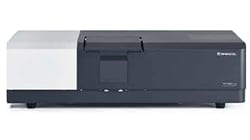
UV-3600i Plus


An integrating sphere is generally used in measurements of the reflectance of samples which display scattering or diffuse reflectance, such as solids and cloudy liquids. An integrating sphere is spherical in shape with an inner wall made of barium sulfate or some other lightscattering material with high reflectance, and has the effect of causing light that enters the sphere (measurement light) to scatter uniformly. This enables highly accurate detection of transmitted light or reflected light from the sample, even when measuring samples with scattering properties. When an integrating sphere is used, it is possible to measure the relative reflectance of a sample compared with the reflectance of a white reference plate as a standard. Pressed barium sulfate (BaSO4) powder is generally used in white reference plates, but this material affects the measurement results, as the moisture contained in the BaSO4 displays absorbance. Details concerning this point were presented in Application News No. A639. Fluoropolymer white reference plates and aluminum oxide (alumina, Al2O3) are materials which compensate for the above-mentioned drawback of BaSO4. Fluoropolymer white reference plates have high reflection characteristics across a wide range from the ultraviolet to the near-infrared region, but the material is expensive, and repolishing or replacement is necessary if the plate is soiled. On the other hand, Al2O3 is a low-cost powder regent which is easily refilled if the plate is soiled, and also has high reflection characteristics in the nearinfrared region. In this article, we compared the reflection spectra measured with a UV-3600i Plus ultraviolet-visible light-near infrared (UV-VIS-NIR) spectrophotometer and ISR-603 integrating sphere attachment using Al2O3, BaSO4, and fluoropolymer white reference plates.
January 26, 2021 GMT


