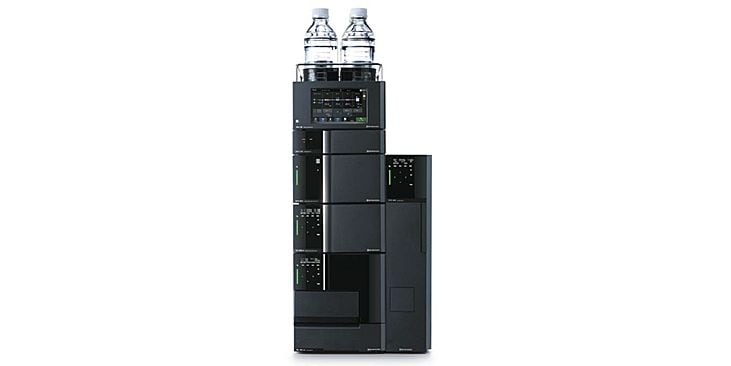
Nexera Series Ultra High Performance Liquid Chromatograph


- A simple and straightforward sample preparation workflow for O-glycan analysis - Lower peeling products in O-glycan sample preparation
Protein glycosylation has been shown to be related to protein activity. It is therefore of great interest to study glycan structures of glycoproteins in immunology and cellular biology. On top of that, it is also essential to analyze glycans in recombinant glycoprotein drugs to ensure consistent glycosylation profile. Glycan can be linked to protein either via asparagine (N-glycan) or via serine/threonine (O-glycan). Previously, we have published an application news on N-glycan analysis. Typical analysis of glycan involves cleavage of the glycan from the protein and subsequently derivatization with fluorescent labels (e.g., 2-aminobenzamide, 2-AB) followed by analysis using HPLC. Unlike N-glycans which have well-established glycan releasing strategy, the O- glycans lack practical method for releasing of intact O- glycans. O-glycan releasing method such as hydrazinolysis often results in large amount of side reaction peeling products and requires long preparation time. This study demonstrates a simplified workflow using the S-Bio EZGlycoTM O-Glycan Prep kit, which exhibits low peeling and a reduced sample preparation time for O-glycan characterization. The solution incorporates the Shimadzu Nexera-i MT system and highly sensitive fluorescence detector (RF-20A).
April 4, 2022 GMT
Some products may be updated to newer models