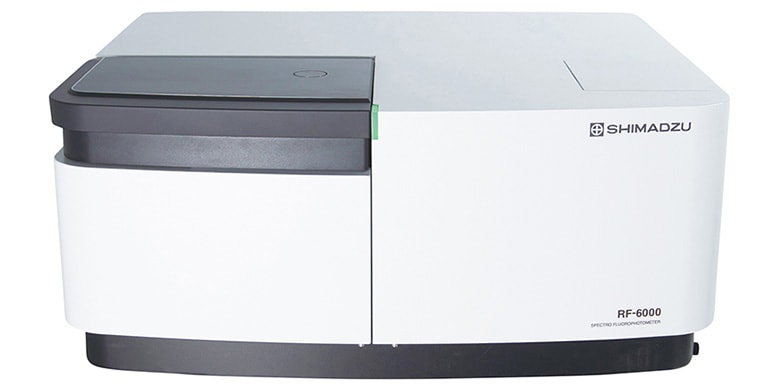
RF-6000


- The excitation wavelength and fluorescence wavelength range of specimens can be checked quickly by using the three- dimensional (3D) florescence spectrum mode search function. - The fluorescence wavelength range of specimens can be confirmed simultaneously with the excitation wavelength from the (3D) florescence spectrum. - Mineral samples can be held as-is by using an optional solid sample holder.
Minerals are compounds that show fluorescence. For example, it is known that calcite, which is composed mainly of calcium carbonate, emits reddish fluorescent light, while fluorite, which consists mainly of calcium fluoride, emits bluish-white fluorescence. Although pure minerals generally show almost no fluorescence, the phenomenon called fluorescence is induced by the mixture of impurities in these minerals. Minerals that display this kind of fluorescence can be analyzed with a spectrofluorophotometer, which measures the intensity distribution of each wavelength by splitting fluorescent light into its constituent wavelengths. The fluorescence of minerals can also be confirmed with ultraviolent light by using a blacklight, but with a spectrofluorophotometer, it is possible to determine the wavelength at which fluorescent light is emitted, since the incident wavelength can be set arbitrarily. This article introduces an example of measurement of the fluorescence of minerals using a spectrofluorophotometer.
June 2, 2022 GMT