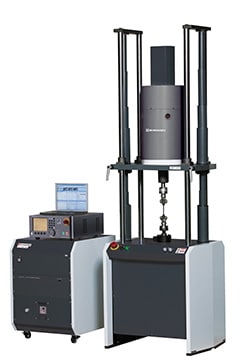
EMT Series


- It is possible to perform endurance testing of bus bars against cyclic loads in practical loading directions. - The high frequency response of the EMT series enables rapid test results at high test frequencies. - By observing the fracture surface, it is possible to determine from which direction the load was applied.
Bus bars are rod-shaped or plate-shaped conductors used to connect and distribute power in distribution panels and control panels. They are very useful as power electronics components because they can conduct large currents. They can conduct large currents because they have the following advantages compared with conventional cables. - Bus bars are made of high-purity materials and have low electrical resistance, so they can conduct large currents compared with cables. Cables are usually alloyed to provide ductility and malleability. - Since bus bars have a large surface area, they can dissipate heatmore efficiently than cables. Because of these advantages, in recent years bus bars have been widely used not only for distribution boards and control boards, but also for connecting automotive batteries, motors, inverters, etc., due to the introduction of EVs. When bus bars are installed in automobiles, unlike in distribution boards and control boards, they may be subjected to external loads due to vibration or impact. It is important to evaluate their durability under such conditions. In this article, durability tests were conducted on bus bars in different load directions to evaluate their durability.
July 1, 2025 GMT