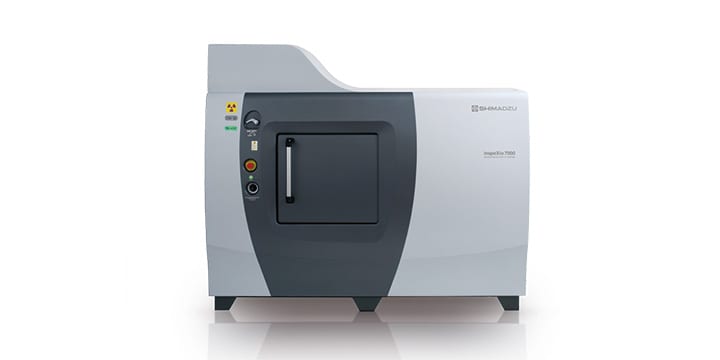
inspeXio™ 7000


- The internal structure of the “4680” cylindrical lithium-ion battery for automotive use, which is a market trend, can be observed nondestructively. - Electrode placement and bonding condition can be verified, which is useful for product quality inspection.
In recent years, with the proliferation of electric vehicles (EVs), the development of high-performance, low-cost automotive batteries has become an urgent priority. Among these, the cylindrical lithium-ion battery “4680” has attracted particular attention. Compared with the conventional “2170,” the “4680” is larger, and its energy density per cell is increased, thereby extending vehicle range. In addition, the adoption of a tab-less structure reduces internal resistance, improving charge/discharge efficiency and thermal management performance, while simplification of the manufacturing process is expected to reduce cost. Owing to these characteristics, the “4680” is drawing attention across both industry and academia as a core technology for next-generation EVs. Meanwhile, lithium-ion batteries are always subject to concerns about the risk of ignition and explosion due to internal short circuits or foreign matter inclusion. Because X-ray CT enables nondestructive testing (NDT) with three-dimensional visualization of internal structures, it is possible to detect fine defects such as electrode misalignment, separator damage, and foreign matter inclusion. This article introduces a case study in which the cylindrical lithium-ion battery “4680” for automotive applications was observed using the microfocus X-ray CT system inspeXio 7000.
November 4, 2025 GMT