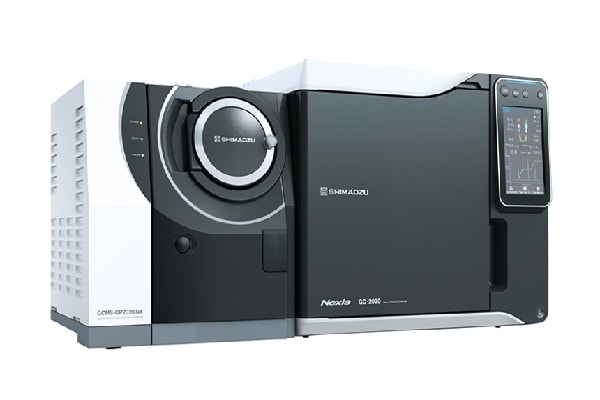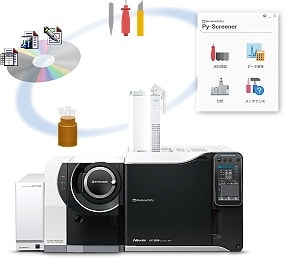
Py-Screener Ver.3


- In just one analysis, Py-Screener Ver. 3 can determine levels of phthalate esters, brominated flame retardants (PBBs, PBDEs), PIP (3:1), UV-328, dechlorane plus (DP), short-chain chlorinated paraffins (SCCPs), and medium-chain chlorinated paraffins (MCCPs). - It can also test for SCCPs and MCCPs by electron ionization (EI) instead of negative chemical ionization (NCI). - PIP (3:1), UV-328, DP, and SCCPs and MCCPs can be screened without the need for corresponding reference materials.
Countries and regulatory bodies worldwide are introducing increasingly stringent regulations on the chemical substances used in electronic devices and industrial products. The RoHS Directive and REACH regulations in the EU, the Toxic Substances Control Act (TSCA) in the USA, and the Stockholm Convention on Persistent Organic Pollutants (POPs) are also targeting an increasingly broad range of substances. Therefore, manufacturers are required to accurately identify regulated substances in their products and comply with each regulation. While Py-Screener Ver. 2 can screen for seven phthalate esters and brominated flame retardants, including substances regulated under the RoHS Directive, version 3 can also screen for PIP (3:1), which is regulated under the TSCA, as well as UV-328, DP, and SCCPs and MCCPs , which are regulated under the Stockholm Convention on POPs. This article introduces the simultaneous analysis of multiple regulated substances and a case study of testing specific regulated substances in samples, using Py-Screener Ver. 3.
February 3, 2026 GMT
This application relates to an invention for which a patent application is pending.
Some products may be updated to newer models