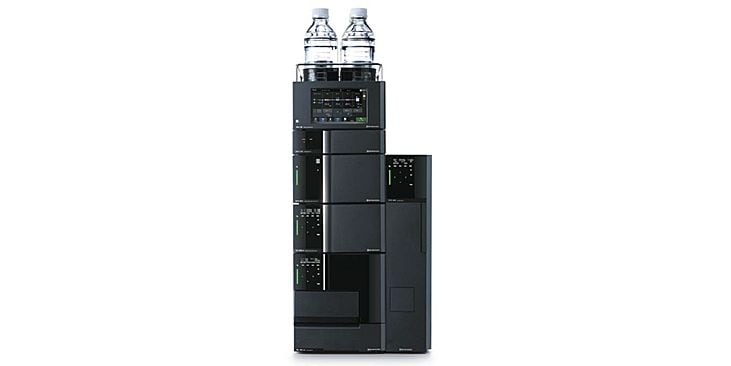
Nexera Series Ultra High Performance Liquid Chromatograph


- Unlike GPC, GPEC enables separation of polymers independent of their molecular weight, supporting multifaceted polymer analysis. - The Nexera Method Scouting System can realize significant labor savings and high efficiency in method development when investigating the separation conditions for GPEC, in which selection of the mobile phase composition to be used and adjustment of the gradient conditions are particularly important.
In polymer materials, analysis and confirmation of the polymer composition in the processes from research and development to quality control are extremely important because the composition has a large influence on the physical properties of the material. Among these polymers, copolymers are polymers which are composed of multiple types of monomers, and the properties of copolymer materials are also known to differ due to differences in the composition and arrangement of their constituent monomers. Therefore, identification and isolation of those components in copolymers are important. Size exclusion chromatography (SEC)/gel permeation chromatography (GPC), in which separation is conducted based on polymer size, is generally used as a polymer separation technique. Because the constituent polymers can be separated by molecular weight, it is possible to obtain information such as the molecular weight distribution, but when the sample contains a mixture of polymers with similar molecular weights and different compositions, separation is not possible. The technique called gradient polymer elution chromatography (GPEC) is useful in such cases, as the polymers are separated according to differences in their composition, independent of the size of the polymer. In the GPEC separation technique, the sample material is injected in a mobile phase with a composition (poor solvent) in which the target polymer is insoluble, intentionally precipitated in the flow path, for example, at the end of the column, and then redissolved and eluted in the flow path by applying a gradient to the mobile phase composition to a composition (good solvent) that easily dissolves the target polymers. Since applying a gradient to the mobile phase composition makes it possible to separate polymers based on differences in their solubility in the solvent, the polymers can be separated according to their compositions. However, because investigation of the GPEC analytical conditions is frequently based on experience, the analytical conditions must be investigated individually for each sample. Thus, the time and trouble required in investigating the separation conditions for GPEC has been a drawback of this technique. The Nexera Method Scouting System can achieve high efficiency in method development work, because the analytical conditions can be screened by automatically changing the type and composition of solvents for the mobile phase, the column to be used, and other analytical conditions. This article introduces an example in which the conditions for a GPEC analysis were investigated efficiently by using the Nexera Method Scouting System and dedicated software Method Scouting Solution, and an analysis of a copolymer and its constituent homopolymers (polymers consisting of only one monomer) was carried out by the GPEC separation technique.
February 11, 2026 GMT
Some products may be updated to newer models