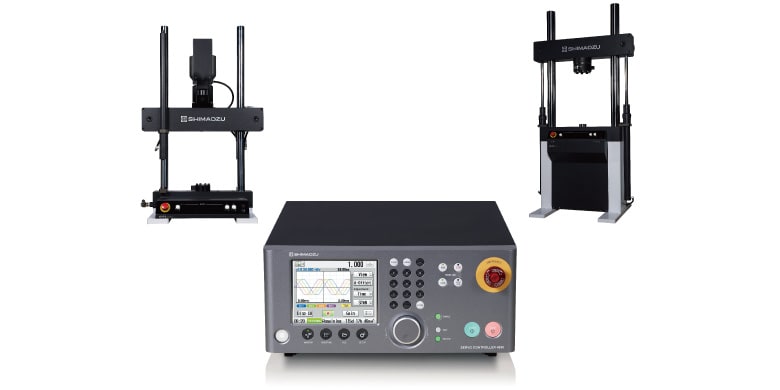
Microservo MMT Series


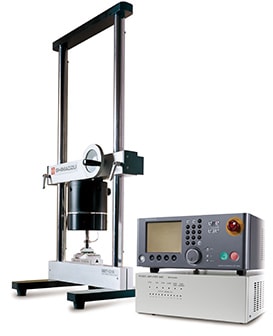
- The durability of solder joints under cyclic bending can be evaluated in with reference to JEITA ET-7409/105A and JIS C 62137-1-4. - By using the Microservo MMT electromagnetic force micro testing system and a resistance measurement unit, changes in the continuity resistance of the solder joint can be continuously measured. - The Servo Controller 4830 can perform high accuracy dynamic control.
Electronic devices have become smaller with higher functionality. This has enabled surface-mount devices (SMDs) to be mounted at high densities on printed circuit boards. However, during the manufacturing process or in the operating environment, circuit boards may be subjected to repeated mechanical loads, such as bending or vibration. This can cause cracks to form at solder joints, leading to contact failures. To address this, the durability of solder joints can be evaluated through cyclic bend tests, which are useful for examining solder alloys, component designs, terminal structures, and mounting conditions, as well as for improving joint reliability. In this article, testing was conducted with reference to JEITA ET-7409/105A and JIS C 62137-1-4. Under cyclic bending loads, the electrical continuity of a solder joint changes as damage progresses, and the continuity resistance tends to increase. By using a resistance measurement unit, continuity resistance can be measured continuously during testing, enabling the state of degradation to be quantitatively determined up to failure.
August 4, 2026 GMT