
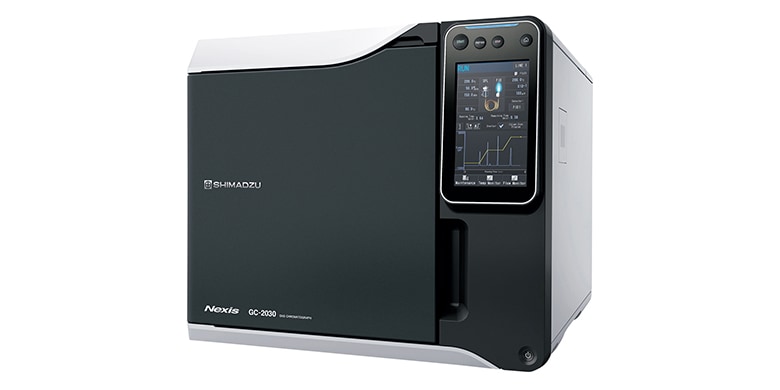
Nexis GC-2030


- Analysis times can be significantly shortened by using the Nexis GC-2030 (230 V), an oven insert, and hydrogen as the carrier gas. - Using dual injectors, throughput can be greatly improved, enabling the analysis of more than 400 samples per day.
Shimadzu’s Nexis GC-2030 can analyse over 400 samples in a single day, due to a highly optimised method that has an injection-to-injection time of less than 7 minutes per sample, or 3.5 minutes per sample, with dual injectors running simultaneously. This method can resolve C10 to C40 alkanes, allowing it to be applied to almost all TPH/TRH applications. C6 to C40 can be resolved with a modified method. During the production and use of petroleum hydrocarbon products, the environment, including waters and soils can be contaminated. Petroleum hydrocarbons do not, in general, biodegrade readily. Furthermore, some pose risks to health, consequently, the control of contamination is important. The analysis of petroleum products in waters and soils is commonly referred to as TPH (Total Petroleum Hydrocarbon) or TRH (Total Recoverable Hydrocarbon), which covers a range of standardised method variants. Some classes of petroleum products pose greater risks than others. Hence, reporting the total concentration of TPH does not provide a reliable basis for evaluating the potential risks to the environment and human health. For this reason, the chromatographic separation is divided into bands and resolves the analytes based on carbon atom (C) numbers.
October 8, 2026 GMT