
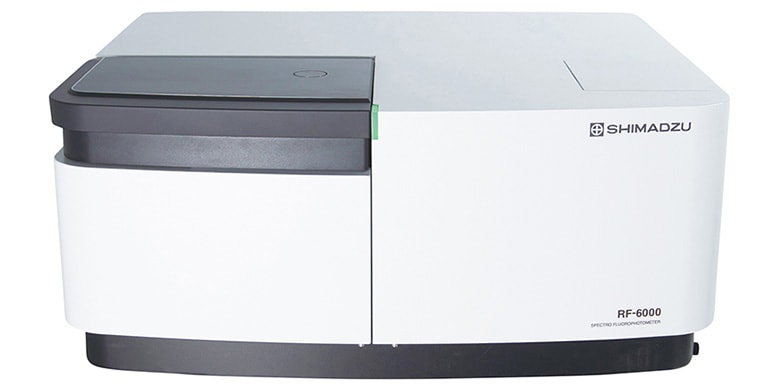
RF-6000


Spectrophotometric Analysis
When a substance absorbs or emits light, those phenomena are accompanied by changes in its electronic state. In absorption, electrons change from the ground state to an excited state, and in light emission, the opposite change occurs, i.e., from an excited state to the ground state. There are energy levels of vibration in each of these states, and energy levels of rotation also exist at each vibrational level. At room temperature, substances display a broad spectrum because, in terms of energy, their electrons are distributed among several vibrational/rotational levels in the ground state, and they transit to the excited state from there. The distribution of the vibrational/rotational levels is influenced by ambient heat. Because distribution to high-order vibrational/rotational levels is suppressed if a substance is cooled, the spectrum becomes sharp, and it is possible to obtain peaks that cannot be measured at room temperature. This article introduces measurements of liquids in a low- temperature state with an ultraviolet-visible (UV-Vis) spectrophotometer and spectrofluorophotometer by using CollSpeK (Unisoku Co., Ltd.)
June 1, 2018 GMT
