


History of the HPV Series

2005
Launch of the HPV-1
● Sensor: IS-CCD
● Performance: Recording speed (frame rate) of 1 million frames per second (Mfps), resolution of approx. 81,000 pixels, recording capacity of 100 frames
The HPV-1 was equipped with an IS-CCD (in-site storage image sensor with charged couple device) featuring a proprietary structure for dedicated high-speed recording. It enabled ultra high-speed recording with a maximum speed of 1 Mfps and 100 consecutive images.
The resolution of approx. 81,000 pixels ensured there was no deterioration in resolution at any recording speed, thus enabling high-quality images with high sensitivity.
With the launch of the HPV-1, it became possible to visualize ultrafast phenomena that were previously imperceivable to the human eye. Since its introduction, this product has contributed to advances in various fields of innovative science and technology.
- HyperVision HPV-1 Wins the 48th “Best 10 New Products Award” in 2005
In 2005, Shimadzu’s HPV-1 high-speed video camera received a Best 10 New Products Award at a ceremony hosted by Nikkan Kogyo Shimbun, Ltd. As the world’s first ultra high-speed video camera that succeeded in recording video images at the previously unheralded speed of one millionth of a second (1 microsecond), the HPV-1 was lauded for its contribution to future industrial development. (January 25, 2006) - HPV-1 High-Speed Video Camera Nominated for U.S. “R&D 100 Awards”
In 2006, Shimadzu’s HPV-1 high-speed video camera was among the winning products at the R&D 100 Awards sponsored by R&D magazine (currently R&D World)—a U.S.-based technical information magazine—which selects 100 technologically significant commercial products from around the world. The HPV-1 was recognized for its groundbreaking ability to record continuous images at the ultra high speed of 1 microsecond (1 μs) without any deterioration in image quality. - HPV-1 High-Speed Video Camera Recognized with a Minister of Economy, Trade and Industry Merit Award for Collaborative Achievement between Industry, Academia, and Government
The HPV-1 was nominated for a Minister of Economy, Trade and Industry Merit Award at the 4th Annual Merit Awards for Collaborative Achievement between Industry, Academia, and Government hosted by the Cabinet Office of Japan. The award was jointly accepted by Professor Takeharu Etoh of Kindai University, Hideki Mutoh, President of Link Research Corporation, and Yasushi Kondo of Shimadzu. This award is conferred to universities, public research institutions, and businesses for outstanding successes contributing to the promotion of industry-academia-government collaboration through major achievements and pioneering efforts. (June 11, 2006) - HPV-1 Receives 11th Annual Fujio Frontier Award from the Institute of Image Information and Television Engineers in 2002

2008
Launch of the HPV-2/HPV-2A
● Sensor: IS-CCD
● Performance: Recording speed (frame rate) of 1 Mfps, resolution of approx. 81,000 pixels, recording capacity of 100 frames, synchronization of up to 4 cameras
Like its predecessor HPV-1, the HPV-2 model was equipped with an IS-CCD (in-site storage image sensor with charged couple device) featuring a proprietary structure for dedicated high-speed recording. It offered ultra high-speed recording with a maximum speed of 1 Mfps and 100 consecutive images. The resolution of approx. 81,000 pixels ensured there was no deterioration in resolution at any recording speed, thus enabling high-quality images with high sensitivity.
The camera unit was approx. 40 % lighter than the HPV-1, resulting in a compact and user-friendly configuration that could be remotely operated. While the HPV-1 only supported single camera recording, the HPV-2 offered a synchronized recording function that enabled 4 cameras to be controlled from a single PC for synchronized recording. Precise synchronized recording between cameras from 2 or 3 directions provided more accurate analysis of three-dimensional (3D) observations as exemplified by the digital image correlation (DIC) method. There have been recent advances in image analysis techniques using the DIC method, particularly overseas. Coupled with Shimadzu’s product lineup of testing machines, the HPV-2 has made a significant contribution to advances in the materials field.
*DIC: Digital image correlation
In the context of strength tests involving deformation of the sample, DIC is a method of analyzing temporal changes in the distribution of sample displacement by recording the deformation and analyzing the resulting images.
More specifically, the method of analyzing the 3D distribution of sample displacement using stereo images recorded by 2 video cameras is called 3D-DIC.
2012
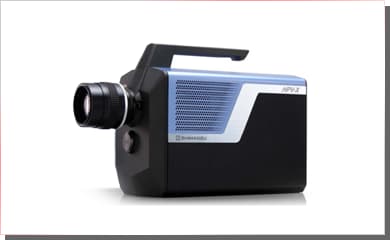
Launch of the HPV-X
● Sensor: FTCMOS
● Performance:
HP mode: Recording speed (frame rate) of 10 Mfps, resolution of 50,000 pixels, recording capacity of 256 frames, synchronization of up to 4 cameras
FP mode: Recording speed (frame rate) of 5 Mfps, resolution of 100,000 pixels, recording capacity of 128 frames
The HPV-X was equipped with a high-speed frame transfer CMOS (FTCMOS) sensor based on the CMOS image sensor.
Inheriting the previous models’ feature of high-speed recording without any deterioration in resolution, the HPV-X allowed ultra high-speed continuous recording at a maximum speed of 10 Mfps, which was 10 times faster than that of its predecessor.
The camera featured two recording modes—HP mode (short for “half pixel”), which prioritized recording speed, and FP mode (short for “full pixel”), which prioritized resolution—to enable recording suited to various test conditions.
Ultra high-speed recording at 10 Mfps enabled users to visualize and observe the processes of various instantaneous phenomena that were previously undetectable. The HPV-X contributed to cutting-edge R&D, including elucidation of physical phenomena and development of new materials, space technologies, and microfabrication.

2015
Launch of the HPV-X2
● Sensor: FTCMOS2
● Performance:
Synchronization of up to 2 cameras
HP mode: Recording speed (frame rate) of 10 Mfps, resolution of 50,000 pixels, recording capacity of 256 frames
FP mode: Recording speed (frame rate) of 5 Mfps, resolution of 100,000 pixels, recording capacity of 128 frames
The HPV-X2 is equipped with the high-speed frame transfer CMOS2 (FTCMOS2) sensor based on the CMOS image sensor.
It enables ultra high-speed continuous recording at a maximum recording speed (frame rate) of 10 Mfps.
Users can select from two recording modes—HP mode (short for “half pixel”), which prioritizes recording speed, and FP mode (short for “full pixel”), which prioritizes resolution.
Now equipped with the FTCMOS2 image sensor, the HPV-X2 realizes an approximately 6-fold increase in light sensitivity compared to previous models.
It also features the synchronized recording function that was offered in the HPV-2 for up to 2 cameras. Shimadzu now offers a software development library to control the camera. By performing data analysis in coordination with the DIC software, users can perform high-precision observation of 3D deformations in recorded objects. The HPV-X2 also allows users to observe various ultrafast phenomena that were previously hard to observe due to a lack of light sensitivity, such as interactions between drug microcapsules and cancer cells, the fuel injection process of an automobile injector, and the ink discharge process of an inkjet printer.
- HPV-X2 Receives the 47th Annual Inoue Harushige Prize
Shimadzu Corporation and Professor Shigetoshi Sugawa of Tohoku University’s New Industry Creation Hatchery Center, Tohoku University, jointly received the 47th Annual Inoue Harushige Prize for “development of a high-speed video camera.” The Inoue Harushige Prize is awarded to researchers and corporations for outstanding technology that has been developed and commercialized by a corporation based on original research by a university or research institute in Japan. The presentation ceremony was held on October 27, 2022, in the Annex Building of the Tokyo Headquarters of the Japan Science and Technology Agency. (October 27, 2022)

2025
Launch of the HPV-X3
● Sensor: FTCMOS3
● Performance: Recording speed (frame rate) of 20 Mfps, resolution of 300,000 pixels, recording capacity of 256 frames, synchronization of up to 2 cameras, externally synchronized frame timing
The HPV-X3 is equipped with the high-speed frame transfer CMOS3 (FTCMOS3) sensor based on the CMOS image sensor.
The HyperVision HPV-X3 doubles the recording speed of the HPV-X2 to offer world-class performance at 20 Mfps.
The HPV-X3 also triples the resolution of its predecessor and maintains image resolution even at its highest recording speed.
Now with a new function that synchronizes the recording with an external frame timing signal, the HPV-X3 simplifies the conventional method of adjusting exposure timing during recording and expands the scope of observable phenomena.
As a pioneer in the manufacture and marketing of high-speed video cameras since 2005, Shimadzu will continue to support various research through the visualization and recording of ultrafast, microscopic phenomena that are invisible to the human eye.