


History of Shimadzu IR
-
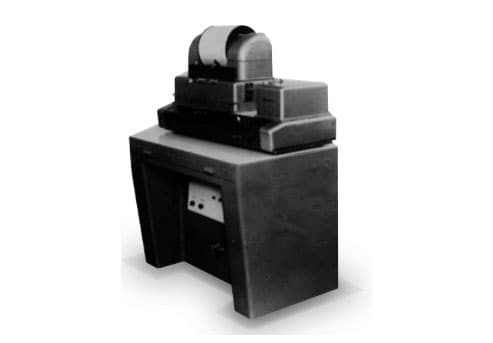
1956
AR-275
Double beam, self-recording infrared spectrophotometer.
After a double-beam self-recording* infrared spectrophotometer was released in the United States, interest in infrared spectrophotometry surged in Japan. Many universities, research institutions, and pharmaceutical and chemical companies adopted the technology, while new infrared-related research societies and discussion groups were established. During that boom period, Shimadzu began developing a similar product. However, as with most development projects, there were technical challenges to address, such as manufacturing high-quality prismatic artificial crystals of rock salt and developing a high-sensitivity thermocouple as the detector. Though we were able to produce our own rock salt crystals, with guidance from the Kyoto University, we solved the thermocouple manufacturing problem by using one imported from the United States. Because rock salt prisms are deliquescent and vulnerable to humidity, manufacturing the crystals required developing a special thermostatic low-humidity chamber. After overcoming these and other difficulties, Shimadzu released its first double-beam self-recording infrared spectrophotometer in 1956 and assigned model names based on the focal length of the collimator mirror.
*“Self-recording” refers to the automatic logging of infrared spectra during photometry, enabling spectra to be obtained simply by pressing a switch and waiting.
-
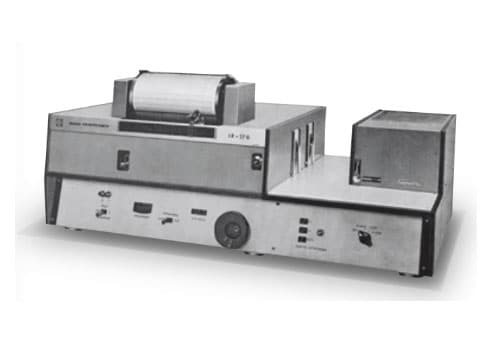
1965
IR-27G
Double beam, self-recording infrared spectrophotometer equipped with a grating, significantly improving maintainability.
To resolve the strict installation site requirements imposed by the deliquescent nature of rock salt prisms, an infrared spectrophotometer was developed using a diffraction grating as the dispersive element. Because a single diffraction grating has a narrow measurement wavelength range, measuring the entire mid-infrared range would require switching between multiple diffraction gratings. To overcome this, we invented a unique sliding mirror mechanism. In addition, an infrared interference filter developed by a venture company in the U.S. was used to eliminate problems with higher-order wavelengths, a characteristic issue of systems with diffraction gratings. After incorporating these innovations, Shimadzu released its first double-beam self-recording infrared spectrophotometer in 1965. Eliminating the need to control the atmosphere in a special thermostatic low-humidity chamber significantly improved ease of maintenance and allowed more installation flexibility.
-
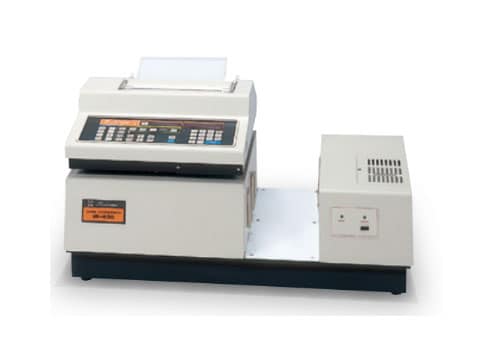
1981
IR-435
Double beam, self-recording infrared spectrophotometer equipped with a built-in data processor and parallel printer.
The IR-435 was Shimadzu’s first double-beam self-recording infrared spectrophotometer with a built-in microprocessor. Incorporating a microprocessor significantly improved the system’s functionality, enabling data processing for spectra logging, differential spectra processing, and peak detection. During that same period, Shimadzu developed and released the IR-400 and IR-440 dispersive infrared spectrophotometers and many other products.
-
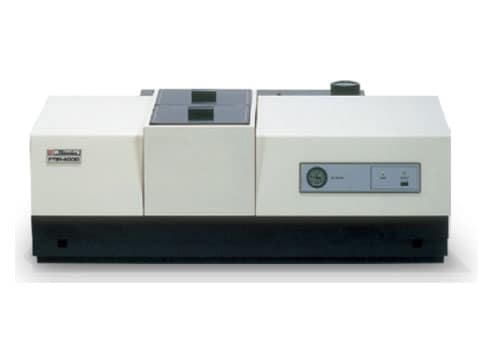
1984
FTIR-4000
A Fourier transform infrared spectrophotometer that greatly improved light efficiency compared to the split-type model.
Dispersive infrared spectrophotometers have a low percentage of light throughput and low detector sensitivity, making the measurement of micro-samples difficult. They also require long measurement times with noise suppressed. The FTIR-4000, Shimadzu’s first FTIR spectrophotometer, addressed these limitations. Equipped with air bearings, it achieved a maximum resolution of 2 cm-1. To provide users comfortable with the dispersive IR models popular at the time, it offered a choice between double-beam and single-beam systems. The system was large, weighing 115 kg, and its dedicated control unit featured a monochrome CRT display and an 8-inch floppy disk port. After the release in 1988 of the IR-470, its last dispersive infrared spectrophotometer, Shimadzu transitioned its product line to FTIR systems.
-
1990
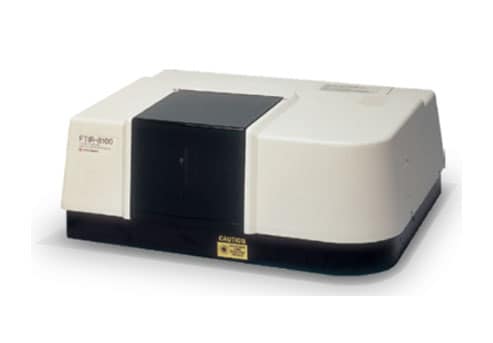
FTIR-8100
Reduced both size and cost, while also providing multi-functional, high-end performance.
This high-resolution (maximum resolution 2 cm-1) model featured a fresh look and included both a flexible joint system (FJS) mechanism and a dynamic alignment mechanism. With performance and pricing competitive with U.S. manufacturers, market share increased rapidly. Although it featured a dedicated control unit, operability was significantly better than that of the previous series as users could measure spectra, enlarge/reduce the window size, and conduct data processing via the keyboard’s function keys.
-
-
2002
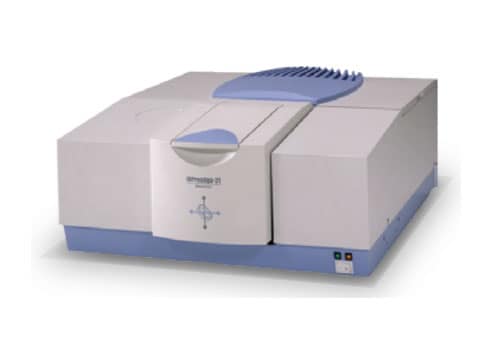
IRPrestige-21
High-end FTIR equipped with a newly developed interferometer, achieving the industry's highest S/N ratio of 40,000:1.
Previous FTIR spectrophotometers had limitations when attempting to expand the measurable wavenumber range. To address this issue, the dynamic alignment mechanism was improved so that interference conditions during beam splitter replacement could be optimized via software. In addition, detector improvements increased sensitivity and a built-in dehumidifier simplified maintenance. Incorporating these technological advances, the IRPrestige-21 (maximum resolution 0.5 cm-1) was released with the highest S/N ratio available at the time and second-generation IRsolution software.
-
2008
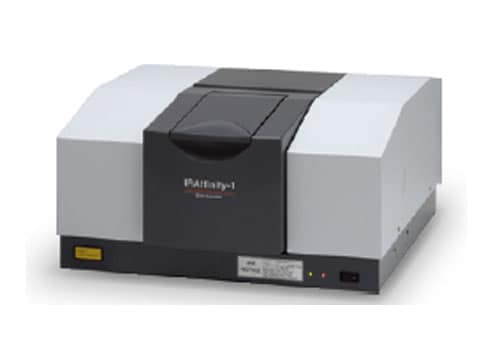
IRAffinity-1
Reduced size by 20 % compared to conventional models. Equipped with a new foreign particle analysis program.
A successor to the line of general-purpose FTIR spectrophotometers, the compact IRAffinity-1 featured advanced functionality and significantly better specifications, in terms of both hardware and software. The instrument achieved an S/N ratio of 30,000:1 or higher and a maximum resolution of 0.5 cm-1, which were the highest performance levels available in a general-purpose model at the time. Improved optics reduced the installation footprint by approximately 20 %, while an integrated automatic desiccator electrolytically removed moisture from the interferometer, simplifying maintenance. The software included a Contaminant Analysis Program and a Pharma Report Program as standard, providing powerful support for analysis operations. The Contaminant Analysis Program enabled accurate, efficient identification of multiple constituent substances, while the Pharma Report Program supported pass/fail assessment for material acceptance and product shipping inspections.
-
2013
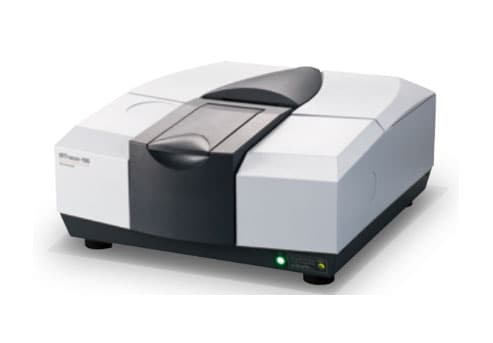
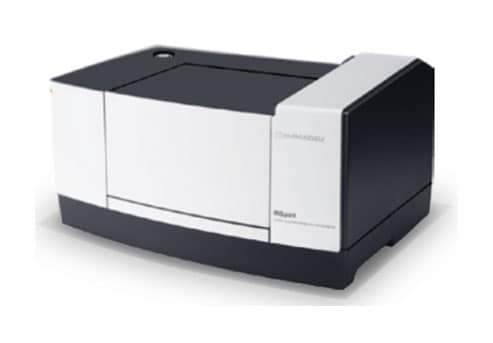
IRTracer-100
Achieved high performance with a S/N ratio of 60,000:1 and resolution of 0.25 cm-1.
Maximum resolution was significantly improved to 0.25 cm-1 and the S/N ratio to 60,000:1, a S/N performance more than 60 times as high as available in models offered about 30 years ago. The IRTracer-100 also introduced rapid scanning functionality for high-speed scanning of the moving mirror and faster measurements. In addition, the IRTracer-100 was the first model to adopt the third-generation LabSolutions IR software, which significantly improved operation and functionality.
-
2017
IRSpirit
A compact, high-performance FTIR with an A3-size footprint and a weight of 8.5 kg.
Released in 2017, the space-saving IRSpirit series was developed to meet the needs for more compact systems that enabled more efficient use of laboratory space and could fit in confined locations. The IRSpirit was significantly smaller and lighter than the previous model, requiring only about 1/7 the installation space and weighing about 1/14 as much, allowing it to be carried by one person. Despite its compact size, it maintained the versatility of previous models with a large sample compartment that could accommodate a wide variety of accessories. Furthermore, by incorporating user feedback, the design enabled access from two sides for improved usability. It was also equipped with the IR Pilot analysis navigation program that includes 23 application modules that ensure even inexperienced users can easily operate the system, from measurement to printing out results.
-
2022
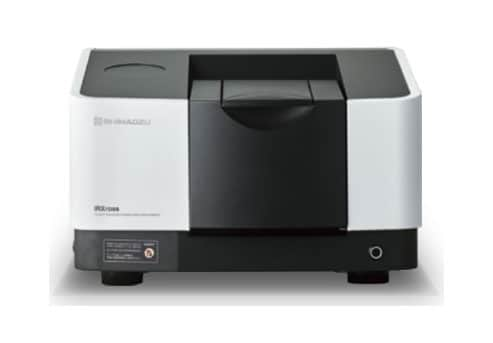
IRXross
Achieved S/N comparable to high-end instruments while maintaining a mid-class size.
This system was developed based on the flagship model and released as a mid-range FTIR system. Except for wavenumber range extendibility and the S/N ratio, it offers performance equivalent to the IRTracer-100. It achieves an S/N ratio of 55,000:1 or higher, the highest in its class, enabling fast acquisition of high-quality data. In addition, resolution as high as 0.25 cm-1, detailed peak separation, the ability to track chemical reactions with high-speed measurements at up to 20 spectra per second, and other capabilities enable advanced analysis. Furthermore, the window plate material can be selected from two options to suit the installation environment.
-
2022
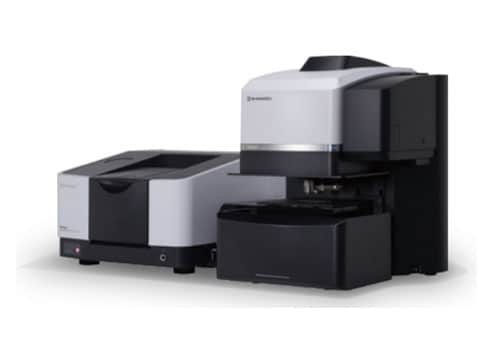
AIRsight
Unique instrument combining infrared and Raman microscopes, enabling one-stop infrared and Raman analysis.
This was released as the world’s only system that combines an infrared microscope and Raman microscope in a single unit. Its most distinctive feature is its ability to acquire both infrared and Raman spectra from the same location without having to move the sample. As a result, both infrared spectra, superior for identifying organic substances, and Raman spectra, well-suited for analyzing inorganic substances and carbon materials, can be utilized in a complementary manner that dramatically improves the accuracy of microcontaminant and defect analysis. In addition, dedicated software allows operators to manage and analyze both infrared and Raman data in one place, enhancing usability and workflow efficiency. The integrated design also saves valuable laboratory space.
-
2023
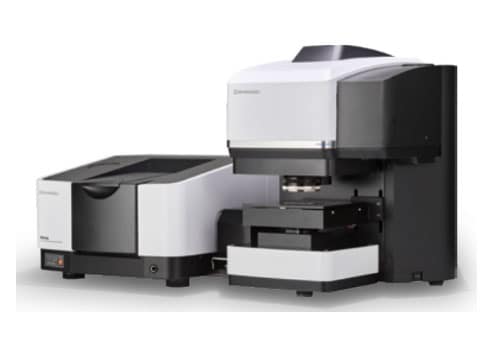
AIMsight
Equipped with a wide-field camera, enabling an easy "Observe > Measure > Analyze" infrared analysis process.
The AIMsight infrared microscope supports quick and accurate analysis of microcontaminants. A key feature is its viewing functionality that combines both a wide-field camera and microscope camera to enable easy transition from checking large areas of a sample to inspecting targeted micro-areas. In addition, its high S/N ratio enables the acquisition of high-quality spectra from extremely small samples. Dedicated software ensures intuitive operation for all users, from measurement to data analysis.
-
2023
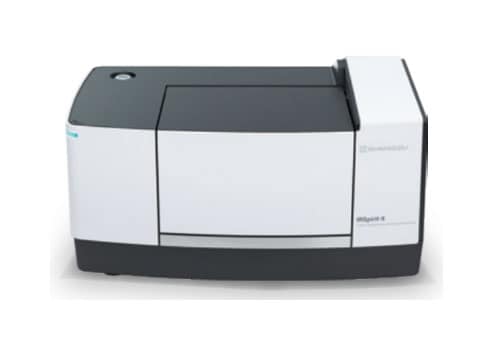
IRSpirit-X
A compact, high-performance FTIR designed for both simple operation and reliability, backed by a 10-year warranty.
The IRSpirit-X series was released as a more advanced compact FTIR spectrophotometer. In addition to the IR Pilot program, which interactively guides users during analyses, IRSpirit-X systems include Spectral Advisor as a standard function that provides recommendations on improving the quality of acquired spectra. A 10-year warranty* is also offered to provide peace of mind. Three models are offered, the LX, TX, and ZX. The IRSpirit-ZX model, equipped with a ZnSe beam splitter, is suitable for use in hot and humid environments.
* This warranty does not cover consumables, accessories other than the FTIR main unit, PCs and peripherals, instruction manuals, jigs, and labor charges for the second and subsequent years. Consumables include a window plate and an optional dehumidifier.