

1.3. Ionization and Mass Separation
1.3.1. What is Ionization?
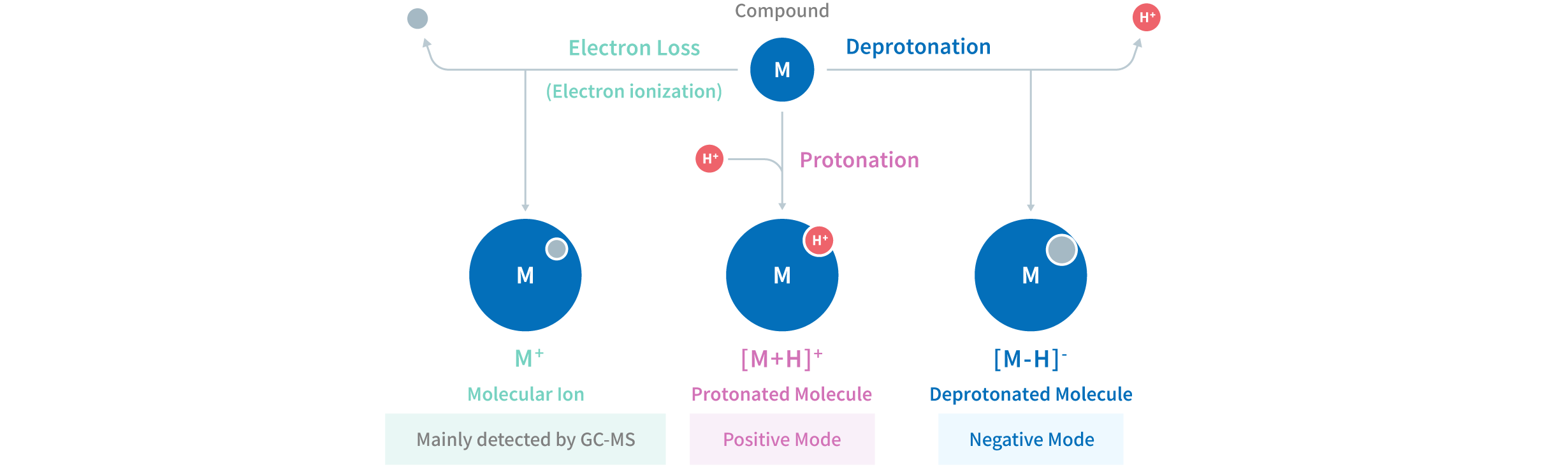
In mass spectrometry, atoms and molecules must be ionized to be separated and detected based on differences in mass and charge number. An ion is a type of charged particle. In LC/MS , when a compound is ionized, it becomes either a deprotonated molecule [M-H]⁻ or a protonated molecule [M+H]⁺. The deprotonated molecule is detected in negative mode, while the protonated molecule is detected in positive mode. In contrast, with a gas chromatograph mass spectrometer (GC-MS), compounds generally release electrons and become positively charged molecular ions M⁺•
1.3.2. What are Fragment Ions?
When ionized compounds collide with inert gas, they break apart and generate fragment ions. This process, which uses collisions with inert gas to break ions, is called collision-induced dissociation (CID). In CID, bonds with lower energy are cleaved first, so the fragmentation pattern reflects the molecular structure.
A specific ion, known as a precursor ion, that generates fragment ions is called a product ion. If a compound reaches the detector as a precursor ion, information about the compound’s mass is obtained. If product ions generated by CID are detected, information about the partial structure of the compound is obtained. By observing precursor ions and product ions, it is possible to estimate the molecular structure of the compound.

1.3.3. What is m/z?
In mass spectrometry, ions are separated by differences in mass and charge number, but strictly speaking, they are separated by differences in m/z, read as “m over z”.
m/z is the abbreviation representing the dimensionless quantity formed by dividing the ratio of the mass of an ion to the unified atomic mass unit by its charge number, regardless of sign (IUPAC Recommendations 2013). In other words, it is the value obtained by dividing the mass of the ion (m), expressed in unified atomic mass units, by the charge number (z).

m/z should always be written in lowercase italics. When indicating the value of m/z, do not use an equals sign; instead, write “m/z 100” with a space.
Column: “The ratio of the mass of an ion to the unified atomic mass unit”
The definition of m/z includes the phrase “the ratio of the mass of an ion to the unified atomic mass unit.” While this may seem complex at first glance, it simply refers to the numerical value of an atom’s or molecule’s mass when expressed in unified atomic mass units (u). Let’s illustrate this with an example using a carbon-12 atom (12C).
The molar mass of 12C is experimentally determined to be 0.012 000 000 0126 kg mol−1. Based on the Avogadro constant (6.022 140 76 × 1023 mol−1), the mass of a single 12C atom is calculated as 1.992 646 88 × 10−26 kg. Since the unified atomic mass unit (1 u) is defined as 1.660 539 068×10−27 kg, dividing the atom’s mass by this unit yields 12.000 000 00.
Because this value is the result of dividing a mass in kg by another mass in kg, the units cancel out, making it a dimensionless quantity. This result aligns perfectly with the calculated exact mass of 12C, which is 12.000 0000 u when expressed in unified atomic mass units.
Column: “Mass-to-Charge Ratio”
While the term "mass-to-charge ratio" is often used, it’s actually a good idea to stick with the abbreviation m/z whenever possible.
The reason for this—as noted in the IUPAC Recommendations—is that the word "charge" can be a bit ambiguous. It doesn't clearly distinguish between electric charge (q), which is a physical quantity measured in Coulombs, and the charge number (z), which is a dimensionless value.
- Electric charge (q): A physical quantity representing the amount of electricity (measured in Coulombs, C).
- Charge number (z): A dimensionless value representing the number of elementary charges.
1.3.4. High-Resolution Mass Spectrometer
A high-resolution mass spectrometer (HRMS) can measure mass precisely to several decimal places, allowing estimation of the atomic composition of a molecule. For example, if a compound is analyzed by low-resolution MS and found to have a mass of 28.0, possible elemental compositions include CO, N₂, and C₂H₄, but the exact composition cannot be determined. However, an HRMS can determine the mass as 28.031, which is closest to the calculated exact mass of C₂H₄, so the compound is identified as C₂H₄. Thus, knowing the precise mass to decimal places enables determination of a compound’s composition.

The calculated exact masses and isotopic abundances of the main elements that make up molecules analyzed by an LC-MS are shown below. These data are used when estimating the composition of compounds with a high-resolution mass spectrometer.
| Calculated Exact Mass and Isotopic Composition of Main Elements in LC/MS Analysis | ||||
|---|---|---|---|---|
| Isotope | Calculated Exact Mass (u) | Isotopic Composition | Standard Atomic Weight | |
| H D |
1 2 |
1.007 825 032 23(9) 2.014 101 778 12(12) |
0.999 885(70) 0.000 115(70) |
[1.007 84, 1.008 11] |
| C |
12 13 |
12.000 0000(00) 13.003 354 835 07(23) |
0.9893(8) 0.0107(8) |
[12.0096, 12.0116] |
| N |
14 15 |
14.003 074 004 43(20) 15.000 108 898 88(64) |
0.996 36(20) 0.003 64(20) |
[14.006 43, 14.007 28] |
| O |
16 17 18 |
15.994 914 619 57(17) 16.999 131 756 50(69) 17.999 159 612 86(76) |
0.997 57(16) 0.000 38(1) 0.002 05(14) |
[15.999 03, 15.999 77] |
| F | 19 | 18.998 403 162 73(92) | 1 | 18.998 403 163(6) |
| P | 31 | 30.973 761 998 42(70) | 1 | 30.973 761 998(5) |
| S |
32 33 34 36 |
31.972 071 1744(14) 32.971 458 9098(15) 33.967 867 004(47) 35.967 080 71(20) |
0.9499(26) 0.0075(2) 0.0425(24) 0.0001(1) |
[32.059, 32.076] |
| Cl |
35 37 |
34.968 852 682(37) 36.965 902 602(55) |
0.7576(10) 0.2424(10) |
[35.446, 35.457] |
| Br |
79 81 |
78.918 3376(14) 80.916 2897(14) |
0.5069(7) 0.4931(7) |
[79.901, 79.907] |
1.3.5. Monoisotopic Mass and Most Abundant Mass
Because mass spectrometry can resolve individual isotopes, rather than relying on average molecular weight, the exact mass—calculated based on a specific isotopic composition—serves as an indispensable parameter for identifying compounds.
A key concept in this context is the monoisotopic mass. According to the IUPAC Recommendations 2013, it is defined as the "exact mass of an ion or molecule calculated using the mass of the most abundant isotope of each element." This value is a critical parameter for compound identification, structural analysis, and the development of analytical methods.
An ion consisting solely of the most abundant isotopes for each element is called a monoisotopic ion, and its signal in a mass spectrum is referred to as the monoisotopic ion peak. Peaks originating from ions that contain other isotopes are known as isotopic ion peaks.
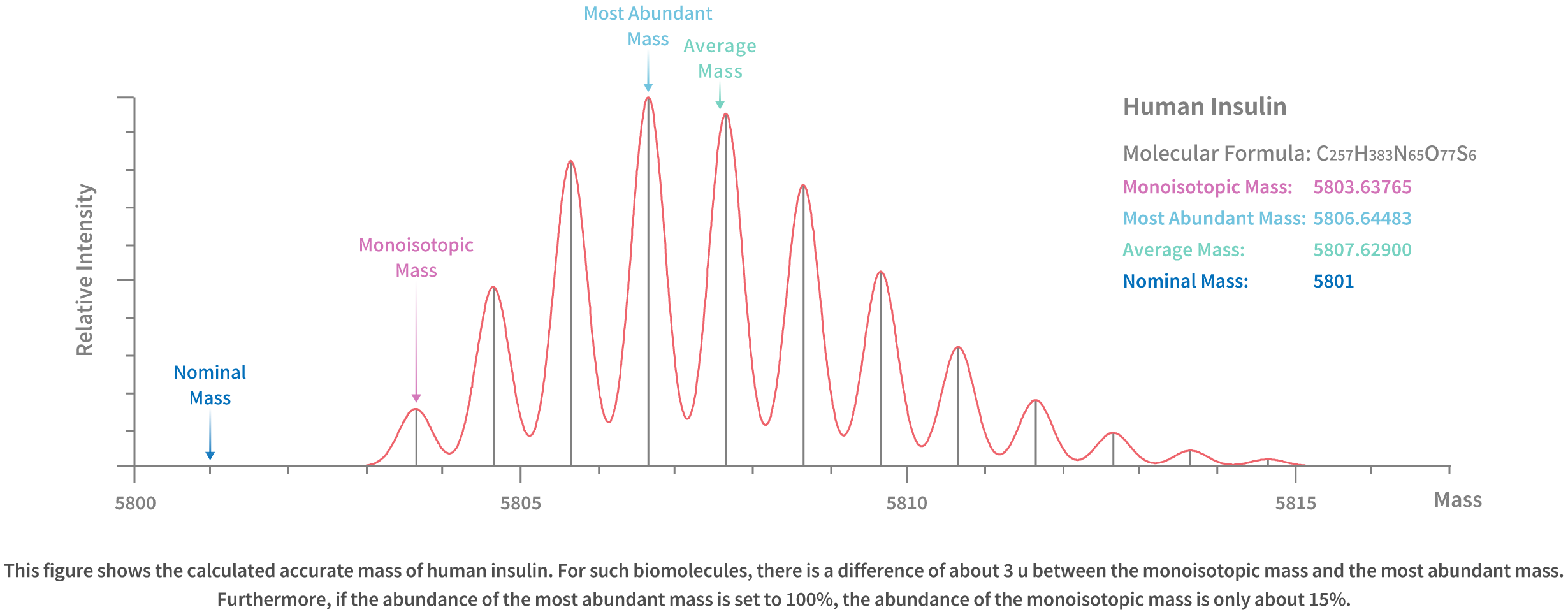
Furthermore, the mass of the isotopic combination that has the highest probability of occurrence in a given ion or molecule is called the most abundant mass. For small molecules, the monoisotopic mass and the most abundant mass are often the same. However, with macromolecules such as proteins, the intensity of the most abundant mass can be more than ten times greater than that of the monoisotopic mass. For these large analytes, the most abundant mass provides the vital information necessary for qualitative analysis and detection.
Column: Isotopic Composition
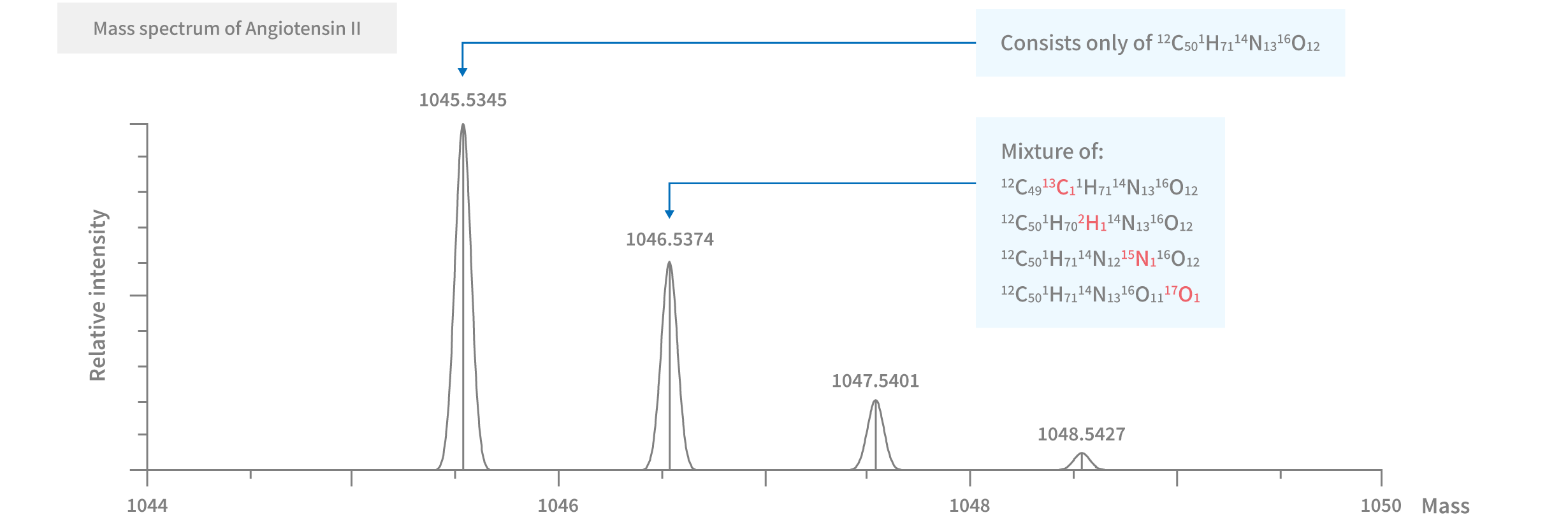
Many elements have isotopes. For example, angiotensin II, a peptide composed of C₅₀H₇₁N₁₃O₁₂, has a monoisotopic mass consisting only of ¹²C, ¹H, ¹⁴N, and ¹⁶O. However, isotopic molecules with a mass 1 u higher include four types, each containing one of ¹³C, ²H, ¹⁵N, or ¹⁷O. Although each molecule has a different mass, the differences are very small, making separation difficult. While it is possible to calculate the mass of each molecule, it is difficult to accurately calculate the average value considering isotopic abundance. Therefore, qualitative analysis is generally performed using the reliably calculated monoisotopic mass.
Column: Atomic Weight and Molecular Weight
The masses of atoms and molecules are often expressed as atomic weight (relative atomic mass) or molecular weight (relative molecular mass). According to IUPAC, atomic weight is defined as a relative value based on the average mass of isotopes in their natural abundance. These values represent the weighted average mass of an element or compound, taking into account the natural abundance of its isotopes. In mass spectrometry, however, a mass spectrum provides distinct mass information for molecules with different isotopic compositions, which are then compared against theoretical values for specific isotopes. For this reason, averaged information like atomic or molecular weight is of limited use in MS analysis. Instead, when comparing experimental data with theoretical calculations, the monoisotopic mass—rather than an average value—becomes the essential parameter.
| Terms | Definitions |
|---|---|
| Monoisotopic Mass |
The exact mass of an ion or molecule calculated using the mass of the most abundant isotope of each element. |
| Most Abundant Mass |
The exact mass of an ion or molecule for the isotopic composition that has the highest abundance. |
| Nominal Mass |
The mass of a molecular ion or molecule calculated using the isotope mass of the most abundant constituent element isotope of each element rounded to the nearest integer value and multiplied by the number of atoms of each element. |
| Relative Atomic Mass (Atomic Weight) |
The ratio of the average mass of the atom to the unified atomic mass unit. Since it is a relative value, it is a dimensionless quantity and has no units. Because natural isotopic abundances vary, IUPAC reports recommended values based on the latest reliable measurements every two years; these are known as standard atomic weights. |
| Relative Molecular Mass (Molecular Weight) |
The ratio of the mass of a molecule to the unified atomic mass unit. The sum of the atomic weights of the atoms that make up a molecule. Like atomic weight, it is a relative value (dimensionless) and has no units. |
| Molar Mass |
The mass per unit amount of substance (1 mol) of an element or compound. In other words, it is the mass of a substance containing 6.022×10²³ particles (the Avogadro constant), which is equivalent to 1 mol. The molar mass is expressed in units of kg/mol or g/mol. When expressed in g/mol, its numerical value is equivalent to the relative atomic mass or relative molecular mass. Note: Historically, the Avogadro constant was defined as the number of atoms in 0.012 kg of carbon-12 (12C). However, following the 2019 redefinition of the International System of Units (SI), the Avogadro constant is now defined as a fixed numerical value: 6.022 140 76 × 1023 mol−1. |
| Unified Atomic Mass Unit |
Defined as one twelfth of the mass of a carbon-12 atom in its ground state. Represented by the symbol u. It is equivalent to the dalton (Da). 1 u = 1.660 539 068 92(52) × 10−27 kg. |
1.3.6. What are Multiply Charged Ions?
In LC/MS, ions with a charge number (z) greater than 1 can be formed; these are called multiply charged ions. As the charge number increases, the value of m/z decreases. This enables the analysis of high-molecular-weight compounds that would otherwise exceed the instrument's m/z range if they were singly charged (z = 1).
Compounds capable of forming multiply charged ions often exhibit a distribution of various charge states. Consequently, even a single analyte can produce multiple peaks in a mass spectrum, which are distinct from its isotopic distribution. For example, in the LC/MS analysis of horse heart myoglobin, a series of multiply charged ions ranging from +10 to +20 is typically observed.
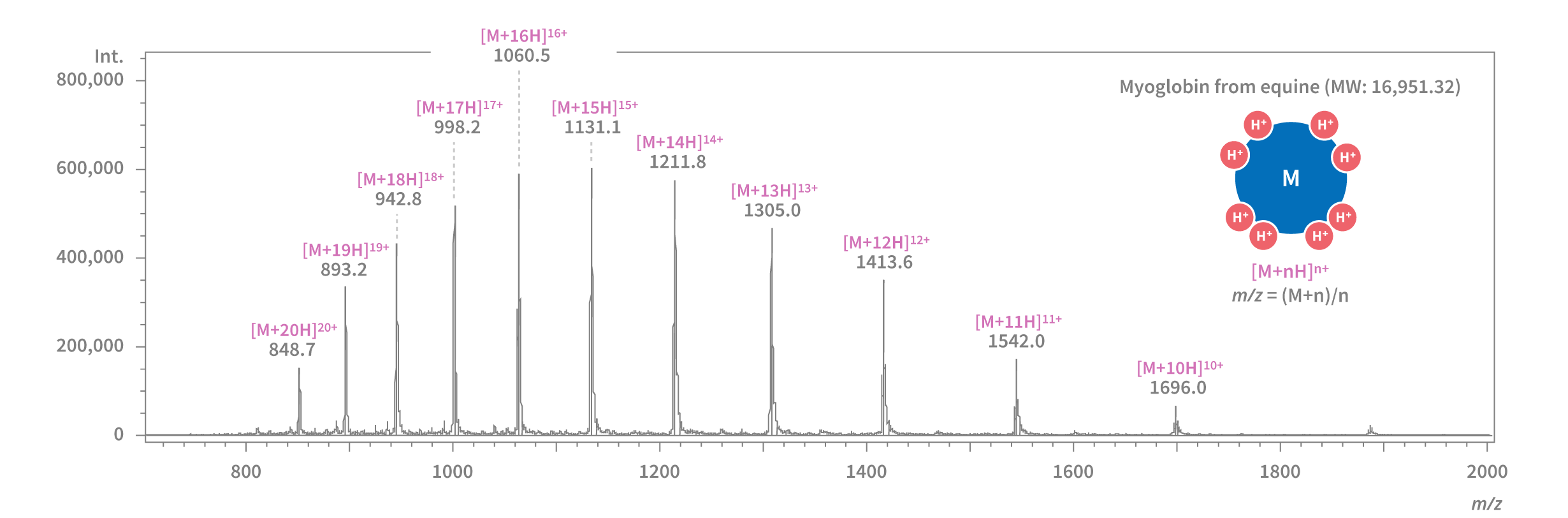
When a series of multiply charged ions is observed, the charge state n of the ion at m/z A can be determined using the formula B / (B − A), where A and B are the m/z values of adjacent peaks (A < B). For example, by focusing on m/z 1131.1 (A) and 1211.8 (B):

This calculation shows that the ion at m/z 1131.1 is a 15+ charged ion, represented as [M+15H]15+.
Once the charge state is known, the molecular mass can be calculated from the m/z value and the charge state n. For example, since the ion at m/z 1131.1 (A) has a charge of 15+, the molecular mass is approximately 16,951.5.

This process of calculating the molecular mass from the m/z values of multiply charged ions is called deconvolution. In software that performs deconvolution, calculations are carried out for all adjacent peak pairs, and the results are weighted according to ion intensity to provide the final mass.
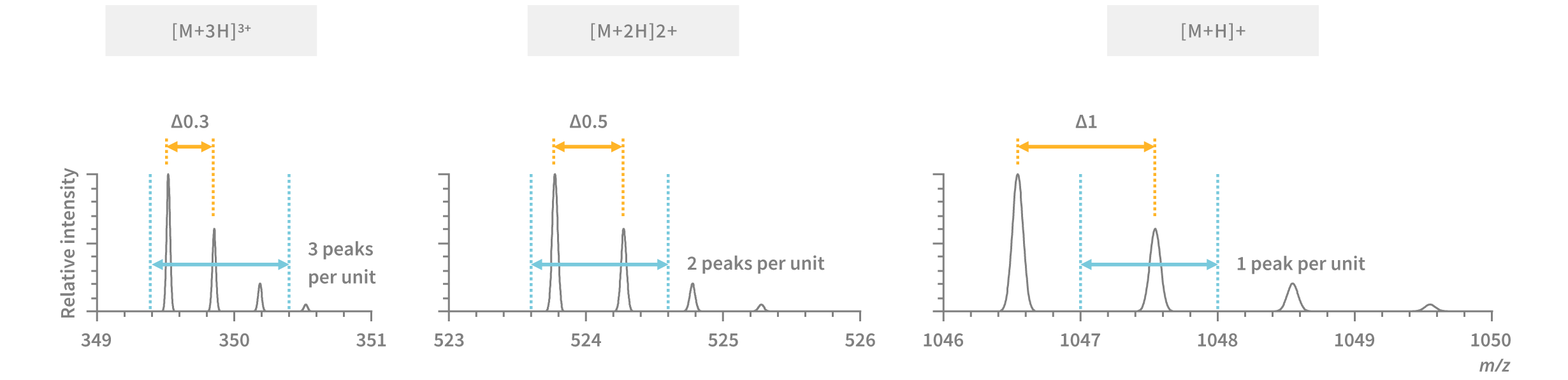
Column: How many isotopic peaks are within one mass unit?
In low-resolution MS, the isotopic peaks of multiply charged ions cannot be resolved; as a result, the observed m/z value typically reflects a value close to the most abundant mass. In contrast, high-resolution MS can measure the mass of individual isotopes, even for multiply charged ions. This capability allows determining the charge state of an ion by measuring the m/z spacing between its isotopic peaks.
The spacing between isotopic peaks depends on the charge state (z). Since isotopes are separated by roughly 1 u in mass, this spacing remains 1 u for a singly charged ion (z=1). However, for a doubly charged ion (z=2), the mass is divided by 2, halving the spacing to 0.5 u. Similarly, for a triply charged ion (z=3), the spacing becomes 0.33 u. By observing how many peaks exist within a single m/z unit, the charge state can be clearly identified.