


1.2. What is Mass?
Mass spectrometry is a technique for obtaining mass information, but the term “mass” here refers to a scale vastly different from the weight measured by a bathroom scale or an electronic balance. In mass spectrometry, values measured using electric and magnetic fields allow us to obtain mass information on an extremely small scale, such as the mass of atoms and molecules.
1.2.1. What is an Atom?
All matter consists of extremely small particles called atoms. Atoms are the fundamental building blocks of matter, and when they gather, they form molecules or physical states such as solids, liquids, and gases. An atom consists of a nucleus surrounded by electrons. The nucleus is made up of protons and neutrons. Protons carry a positive charge, electrons carry a negative charge, and neutrons are electrically neutral.
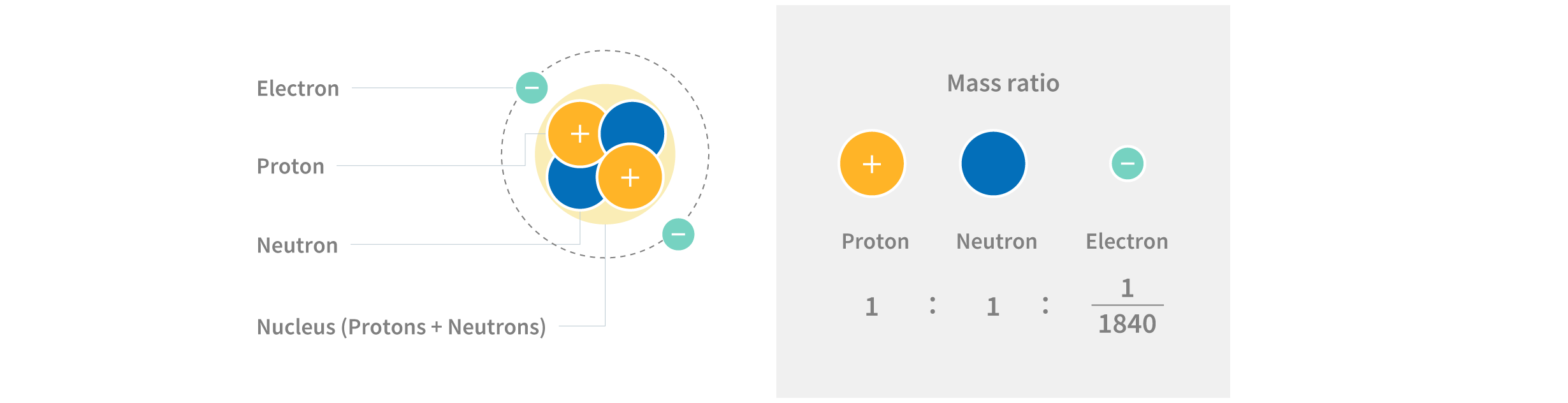
In a normal state, the number of electrons surrounding the nucleus equals the number of protons. Protons and neutrons have nearly the same mass, while the mass of an electron is only about 1/1840 that of a proton. Therefore, the mass of an atom or molecule is determined almost entirely by the number of protons and neutrons.
1.2.2. Elements and Isotopes
The properties of an atom differ depending on the number of protons and neutrons. The number of protons is called the atomic number; atoms with the same atomic number belong to the same element. Elements are the basic units that distinguish types of atoms. In other words, atoms with different numbers of protons have different chemical properties and are considered different elements. The sum of protons and neutrons is called the mass number. Atoms of the same element with different numbers of neutrons have the same chemical properties but different mass numbers; these are called isotopes.

1.2.3. What is a Molecule?
When atoms bond together, they form more complex structures called molecules. Molecules are composed of multiple atoms linked by chemical bonds and represent the basic units that determine the properties of substances. For example, a water molecule (H₂O) consists of two hydrogen atoms and one oxygen atom joined by covalent bonds, giving water its characteristic properties. The diversity of substances around us arises from such combinations of molecular structures.

1.2.4. What is Unified Atomic Mass Unit?
Because the mass of individual atoms and molecules is extremely small, expressing it in grams or kilograms is highly impractical. Therefore, mass spectrometry uses the unified atomic mass unit (u) for atomic and molecular masses.
The unified atomic mass unit is defined as one-twelfth of the mass of a single carbon-12 atom (¹²C) in its ground state and not chemically bounded to any other atom, and its symbol is u.
1 u = 1.660 539 068 92 (52) × 10⁻²⁷ kg, where the value in parentheses indicates uncertainty.
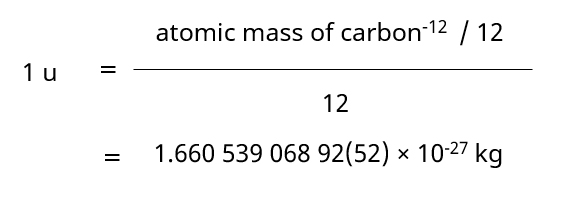
Mass expressed to three or more decimal places using this unit is called the calculated exact mass, which is critical information in mass spectrometry.
Column: Atomic Mass Unit, abbreviated as amu
The unified atomic mass unit was defined in 1960, but before that, the unit called amu was used as the atomic mass unit. It was defined as one-sixteenth of the mass of a single oxygen atom. Although the names are very similar, the definition of the unified atomic mass unit is completely different. Furthermore, in physics, amu was defined as one-sixteenth of the mass of an oxygen atom with a mass number of 16. However, when amu was first defined in 1898, isotopes had not yet been discovered. Therefore, in chemistry, aum was used, which was based on one-sixteenth of the average mass (atomic weight) of oxygen atoms, accounting for their natural isotopic abundance. This difference had a significant impact on high-precision measurements.
To resolve the confusion caused by this duality of units, the “unified” atomic mass unit was defined. For this reason, it is now considered inappropriate to use amu in mass spectrometry. Incidentally, the reason carbon atoms were adopted instead of oxygen atoms is that using carbon reduces the difference compared to masses calculated with amu.
In addition, the use of the symbol Da (Dalton) for the unified atomic mass unit was proposed in 1993 and officially approved in 2005. Da, mainly used in the field of biochemistry, can be used in the same way as u.
Column: Definition of Avogadro’s Constant
With advances in analytical instruments, the International System of Units (SI) was redefined in 2018 and implemented in 2019. At that time, Avogadro’s constant (Na) changed from its previous definition—“the number of atoms in 0.012 kg of carbon-12”—to a fixed numerical value: NA=6.02214076×10²³ mol−1.
Therefore, literature published before and after 2019 may use slightly different values for Avogadro’s constant.
Currently, the mass of one mole of carbon-12 atoms is not exactly 12.000 000 0000 × 10⁻³ kg but rather 12.000 000 0126 (37) × 10⁻³ kg based on experimental measurements.
