


1.1. A What is LC-MS
1.1.1 LC-MS and LC/MS
LC-MS refers to a hyphenated instrument that combines a liquid chromatograph (LC) and a mass spectrometer (MS).
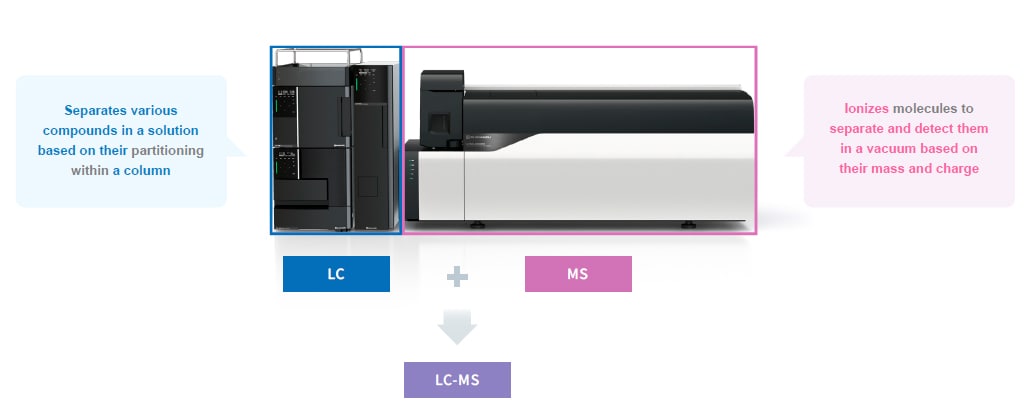
In contrast, LC/MS refers to the analytical coupling of liquid chromatography (LC) with mass spectrometry (MS). In this technique, components in a solution are first separated based on their differential partitioning within an LC column. The eluted components are then ionized in the MS and subsequently separated and detected according to their mass-to-charge ratio.
The distinction of using a hyphen for the instrument and a slash for the technique is a convention advocated by the Mass Spectrometry Society of Japan (MSSJ). The targets of LC-MS analysis are substances dissolved in liquid samples; this system is used for both the identification and quantification of compounds.
| Instrument | Liquid Chromatograph Mass Spectrometer | LC-MS |
|---|---|---|
| Method | Liquid Chromatography Mass Spectrometry | LC/MS |
1.1.2 What is LC?
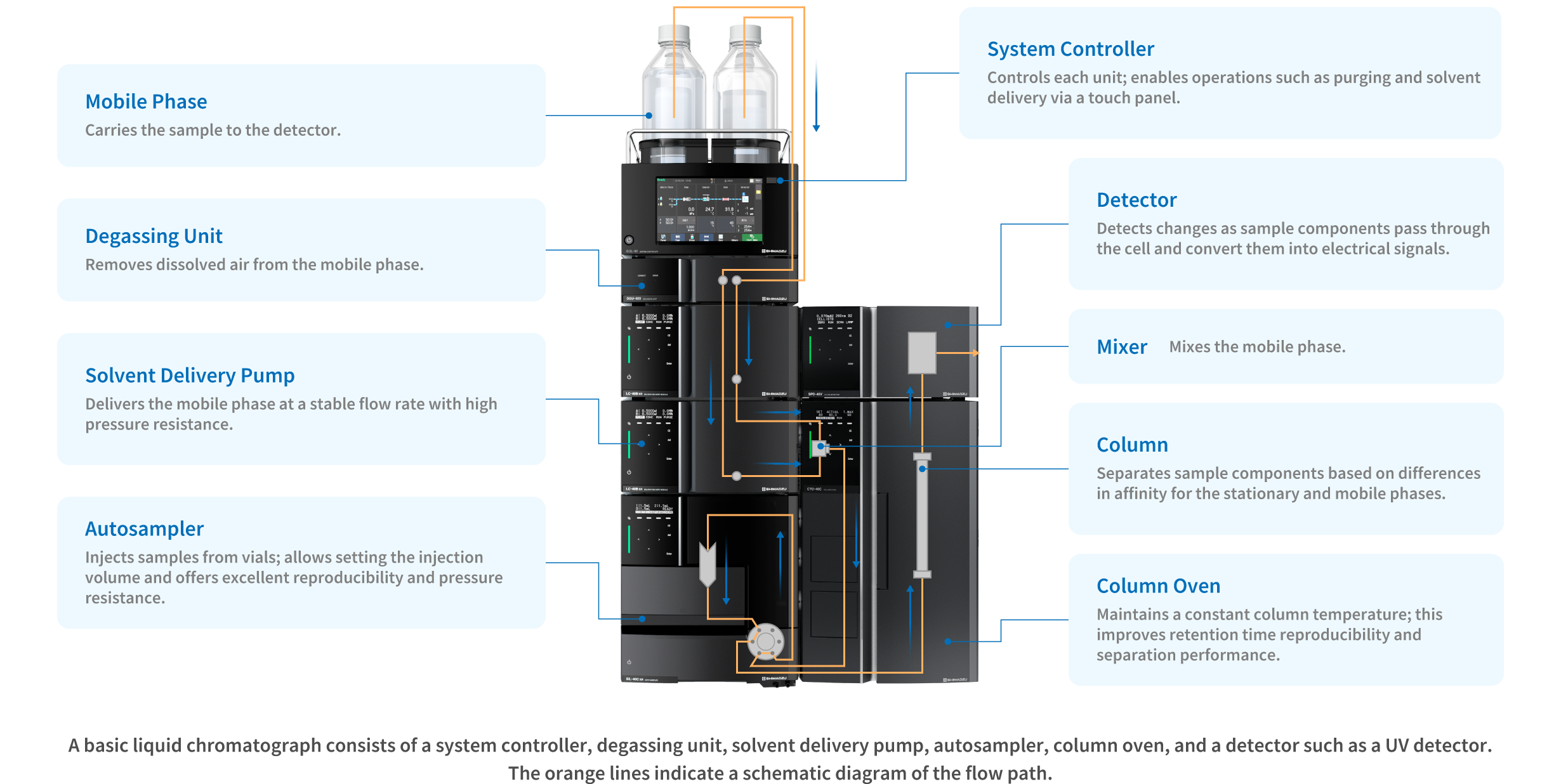
An LC system consists of several units: a pump for delivering liquid, a degassing unit to remove dissolved gases, an autosampler for automated sample injection, a column to separate sample components based on their chemical properties, a column oven to maintain the column at a constant temperature, a detector to sequentially detect components eluted from the column, and a system controller to manage each unit.
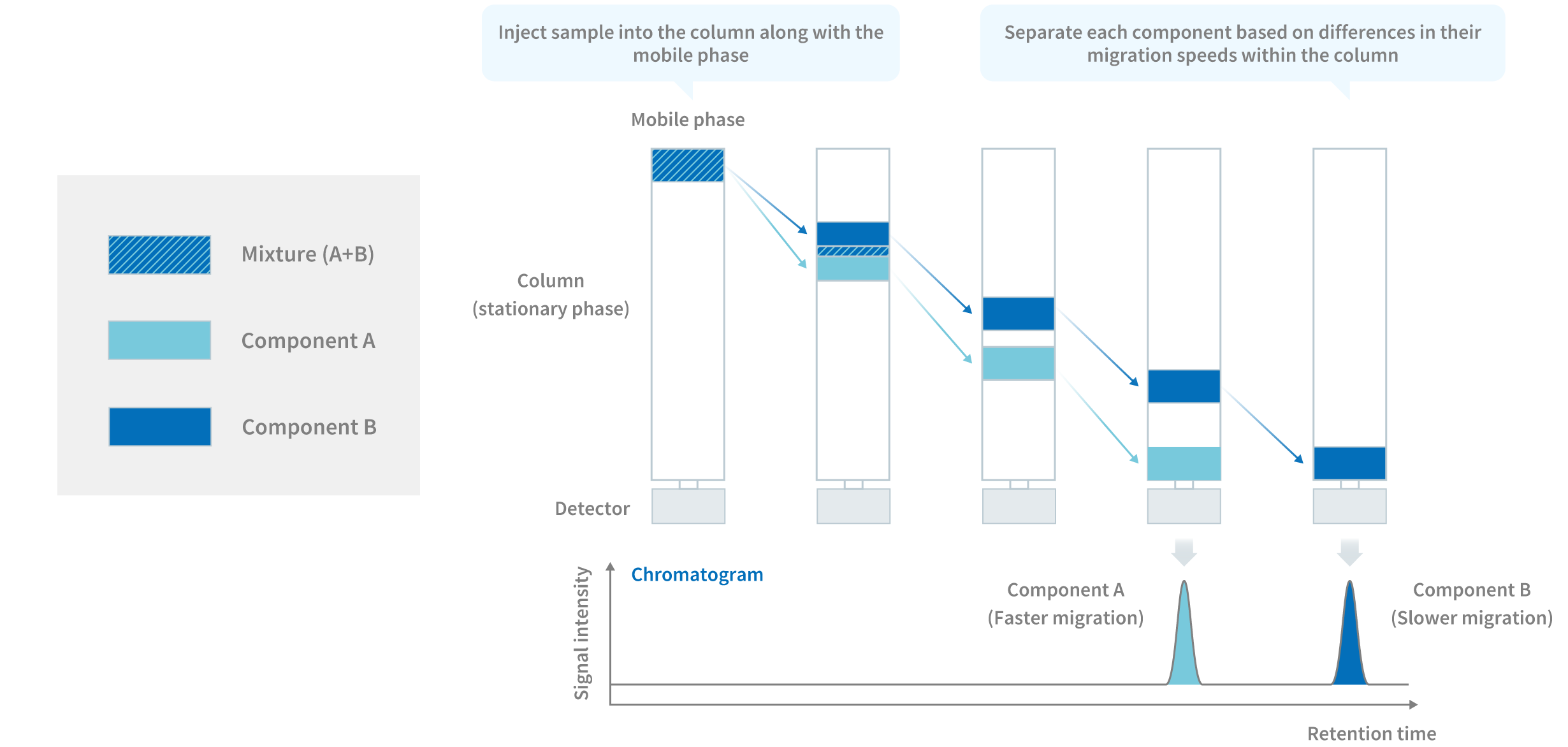
The liquid delivered by the pump is called the “mobile phase”, while the particles packed inside the column with chemically modified functional groups are referred to as the “stationary phase”. The sample injected into the LC system is carried with the mobile phase into the column, where its components are separated as they travel through. Components that interact strongly with the mobile phase elute from the column more quickly, resulting in faster migration and shorter retention times. In contrast, components that interact strongly with the stationary phase elute more slowly, leading to slower migration and longer retention times.
1.1.3 What is MS?
In LC, components separated in the column reach the detector in the order they elute and are detected by absorbance or fluorescence. In contrast, in LC-MS, the eluted components are introduced into the mass spectrometer and ionized. Once ionized, the components are separated according to differences in their mass-to-charge ratio and, upon reaching the detector, are converted into electrical signals for detection. Because atoms and molecules can be separated and individually detected by mass, it is possible to determine the amount of a specific compound in a mixture containing various components.

1.1.4 Benefits of Combining LC and MS
MS is a highly selective instrument capable of separating compounds by mass; however, it is difficult to distinguish compounds with the same mass but different structures (isomers). In addition, when multiple components are introduced into the MS simultaneously, they may interfere with each other, making it impossible to obtain the desired information. By using a column for separation and staggering the timing at which each component is ionized, qualitative and quantitative analysis of individual components becomes easier. For this reason, LC and MS form an extremely powerful combination.
Column: How to Read “MS”
LC-MS is pronounced “L-C-M-S.” Although it may be tempting to pronounce it as “mass,” doing so would make it indistinguishable from the word “mass” (meaning weight). “MS” refers to “mass spectrometer” or “mass spectrometry,” so pronouncing it as “M-S” is appropriate.