Strength Test Types
Purpose of Strength Tests
Material strength tests are standardized procedures used to determine the mechanical properties of a material, primarily categorized into static and dynamic tests. The main purpose of strength testing is measuring the amount of deformation under load on an object.
How Does a Static Test Work?
Static testing refers to a method of strength testing in which a load is applied to a test piece at low speed. Various tests can be conducted depending on how the load is applied to the test piece.
| Tensile Test | |
|---|---|
| Compression Test | |
| Flexural Test | |
| Peeling Test |
How Does a Dynamic Test Work?
Dynamic testing refers to a method of strength testing in which specimens are subjected to loading at high speeds. This method can be classified into the following three types.
| Impact Test | Continuous loading at very high speeds. |
|---|---|
| Fatigue Test | Continuous loading for a given period of time until rupture. |
| Durability Test | Continuous loading until a given number of cycles. |
Types of Strength Tests and Their Corresponding Equipment
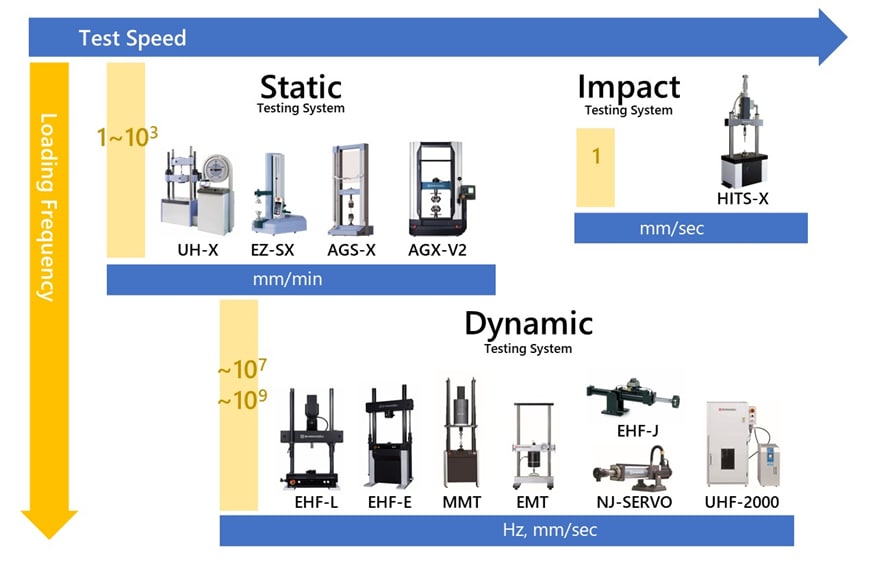
Classification of test types and their corresponding equipment
Hardness and Viscosity Tests
There are also the following types of strength tests. In both cases, the appropriate test equipment must be selected according to the property values that need to be obtained.
- Hardness test: a test to determine the hardness of a material. Hardness is defined differently for each testing method and the values obtained depend on the testing equipment used.
- Viscosity test: a test to measure the fluidity or viscosity of a material. These characteristic values are important when making products from molten materials, such as in injection molding.
FAQ’s
What are the most common material strength tests?
The most common material strength tests include tensile, compression, hardness, and impact testing. These strength test types allow engineers to determine the mechanical limits of a material and ensure safety and compliance.
What is the difference between a static and dynamic test?
A static test applies a slow, constant load to a material to measure its tensile strength or elastic modulus. In contrast, a dynamic test applies rapidly changing or cyclical loads to evaluate how a material performs under real-world stresses like vibration or sudden impact.
When is a dynamic testing system required?
A dynamic testing system is required when a material will be subject to movement, fatigue, or high-speed loading in its final application. This system measures variables that a static test cannot, such as crack propagation and fatigue life over millions of cycles.
Which strength test types are used for metal components?
Key strength test types for metals include hardness testing, impact testing, and fatigue testing. These procedures help determine if a metal can withstand environmental stressors without fracturing.