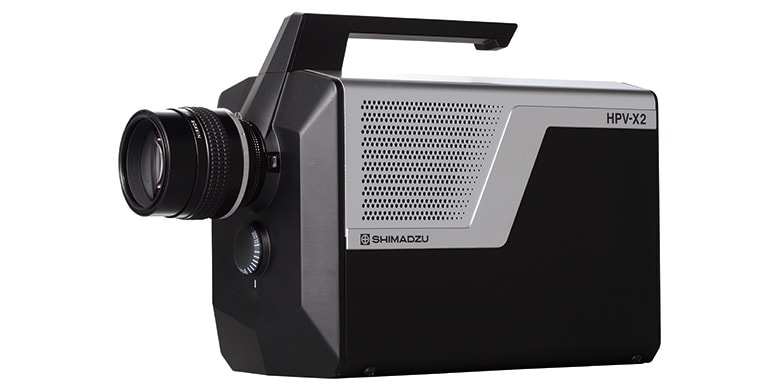
Hyper Vision HPV-X2


High-Speed Video Camera
In recent years, number of smartphones, tablets, and other mobile devices using glass has increased. Because these products must possess the strength to withstand external forces due to bending and dropping, adequate strength is also required in the glass. The strength of glass is evaluated mainly by the 3-point bending test, 4-point bending test, and ring- on-ring test. In the 3-point and 4-point bending tests, fracture frequently originates from damage or a defect at the edge of the specimen, and test results obtained in these tests depend on the condition of the glass edge. On the other hand, the ring-on-ring test can be considered to be biaxial 4-point bending test, and testing unaffected by the glass edge is possible. The obtained strength represents the surface strength of the glass, and is called “in-plane strength”. The ring- on-ring bending test has been standardized in ASTM C1499. According to that standard, tape is applied to the compressive side of the glass specimen, and the condition of the specimen after the test is observed. Since the validity of the test results is decided based on the result of observation, identifying the point of origin of the fracture is considered critical for evaluation of the glass. In this experiment, the fracture behavior of strengthened glass in a ring-on-ring bending test was observed using a Shimadzu Hyper Vision HPVTM -X2 high-speed video camera. The HPV-X2 has a recording speed of maximum 10million frames per second (10Mfps), which not only made it possible to clearly observe the point of origin of the fracture, but also the detailed condition of crack propagation.
April 7, 2020 GMT
Some products may be updated to newer models