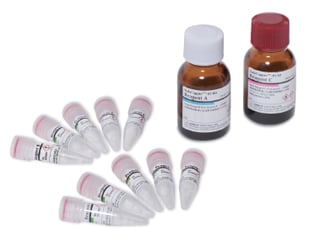
SialoCapper-ID Kit


- The sialic acid linkage types of complicated glycans can be identified without comparing to the analysis results of standard glycan samples. - SialoCapper-ID Kit can be applied to labeled glycans, and therefore sialic acid linkage analysis can be performed without changing the conventional analysis workflow. - Because LC separation is unnecessary, the sialic acid linkage types can be determined only from the MS1 measurement of MALDI-MS.
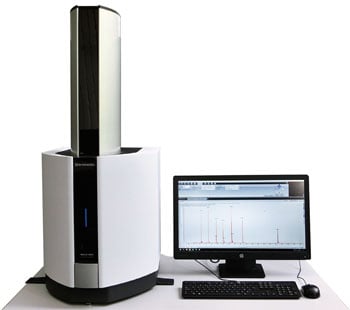
Sialic acid is a family name of acidic monosaccharides, including N-acetylneuraminic acid (NeuAc) and N-glycolylneuraminic acid (NeuGc), mainly present on non-reducing terminal of glycans. Sialic acids can exist with α2,3- or α2,6-linkage types. Such linkage isomer is biologically important, because the difference in linkage types can be associated with various diseases such as virus infection and cancer. In recent years, mass spectrometry (MS) has become widely used to analyze glycans. In particular, the technique of estimating the structure of the glycan from the retention time information in liquid chromatography (LC) and the analysis result of MS is used as a powerful tool. However, it was still challenging to determine the sialic acid linkage types of complicated glycans containing multiple sialic acid residues. In this article, we introduce an example of discriminating sialic acid linage types on PA-labeled glycans by unique derivatization using “SialoCapper-ID Kit” followed by MALDI- TOF MS analysis. Prior to MALDI-MS analysis, the main structure of the glycans was determined by two dimensional LC and LC/MS analysis.
April 28, 2021 GMT