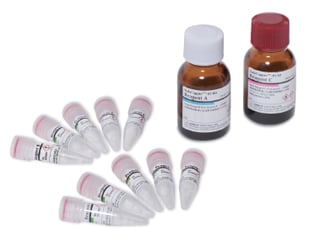
SialoCapper-ID Kit


- Sialic acid linkage isomer can be discriminated only by mass spectrometry without LC separation or sialidase enzyme treatment. - By combining with glycan purification beads "BlotGlyco®," glycan purification and sialic acid derivatization can be performed as a one-pot reaction. - By using the MS2 analysis, the sialic acid linkage can be determined more reliably, omitting the verification by other biochemical experiments.
Protein glycosylation is involved in various biological events. In particular, sialic acid at the non-reducing end of the glycan is important because its presence and linkage type have been implicated in viral infections and cancer. Usually, liquid chromatography (LC) separation and sialidase treatment are used to discriminate sialic acid linkage isomers; however, there are technical problems such as the need for structurally unambiguous standard samples and the difficulty in discriminating complicated glycans. In recent years, sensitive and high-throughput mass spectrometry (MS) has been widely used for glycan analysis. However, there have been some intrinsic problems, such as the loss of sialic acid residues during analysis and the inability to distinguish linkage isomers with the same mass. In this article, we introduce an analysis example of N-glycans released from serum glycoproteins of sialyltransferase knock out (KO) mice. Samples were derivatized using the sialic acid stabilizing kit for linkage isomer discrimination “SialoCapper-ID Kit” followed by analysis using a MALDI-TOF-MS.
April 28, 2021 GMT