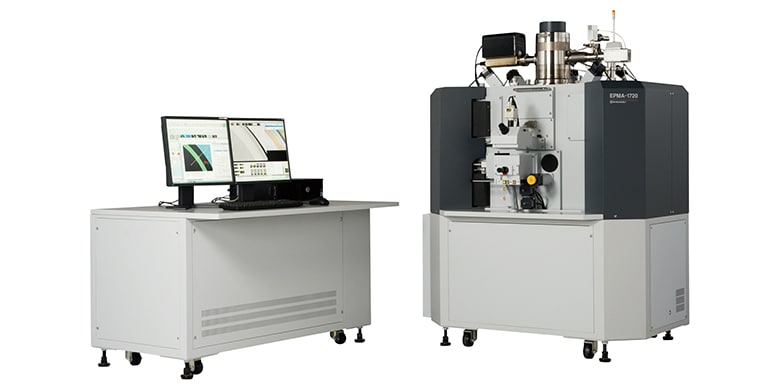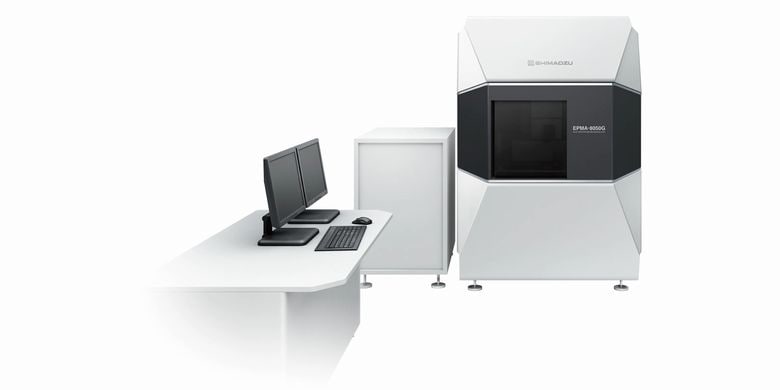
EPMA-8050G


- EPMA enables observation and analysis of the layer interface and layer surfaces of multilayer printed circuit boards for 5G communications and other high frequency applications. - Can be used in research and development of electronic substrates, reliability evaluation, and failure analysis.
Fifth-generation mobile communication systems (5G) are wireless communication systems for realizing high speed and large capacity, massive connectivity, high reliability, and low latency. In Japan, the frequency bands allocated for use in 5G communications are the 3.7 GHz and 4.5 GHz bands, which are called the “sub-6” bands, and the 28GHz band called the “millimeter wave (mmW)” band. All three of these bands achieve higher speed, larger capacity communication in comparison with conventional 4G communications by utilizing higher frequency bands. However, signal deterioration due to dielectric loss is a problem in these high frequency bands. As a solution to this problem, fluoropolymers (e.g. PTFE) and liquid crystal polymers (LCP) have attracted attention as insulating materials for printed circuit boards (PCBs). This article introduces an example of analysis of the interface and surfaces of copper clad laminate (CCL) for 5G applications, which utilizes a low dielectric material, using an EPMA-8050G/EPMA-1720HT Shimadzu EPMATM electron probe microanalyzer.
February 3, 2022 GMT