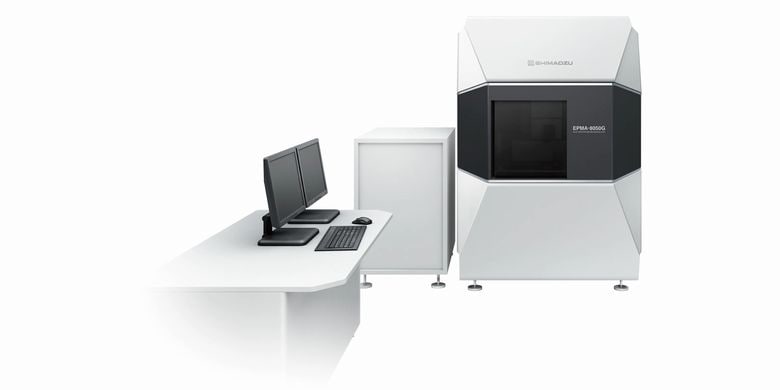
EPMA-8050G


- The mineral structure of sintered ore can be investigated by quantitative mapping of Al, Mg, Si, Ca, and Fe. - This technique is useful in research on the composition of the calcium ferrite phase due to differences in the reduction reaction depending on the furnace temperature. - Phase analysis by quantitative mapping of O and Fe is useful in research on the species of iron oxides.
Reduction of carbon dioxide (CO2) emissions is being promoted with the aim of achieving carbon neutrality in 2050. In the hydrogen reduction ironmaking process, CO2 emissions are decreased by reducing iron ore by using hydrogen (H2) in place of coke (C) to form water (H2O). In Japan, research on a hydrogen reduction technology using hydrogen in the blast furnace (COURSE50) is now underway, including study of reduction of the blast furnace heat requirement and optimization of the raw material reaction conditions, as well as circulating use of gas with a regenerated reduction capacity, by promoting hydrogen reduction, which is a smaller endothermic reaction than direct reduction by coke. The target of the COURSE50 project is a CO2 reduction of 10% or more, and development of Super COURSE50 has also begun with the aim of injecting a larger amount of hydrogen into the blast furnace. This article introduces an example of analysis of sintered iron ore after hydrogen reduction, in which an EPMA (EPMA-8050G) electron probe microanalyzer was used.
March 12, 2025 GMT