
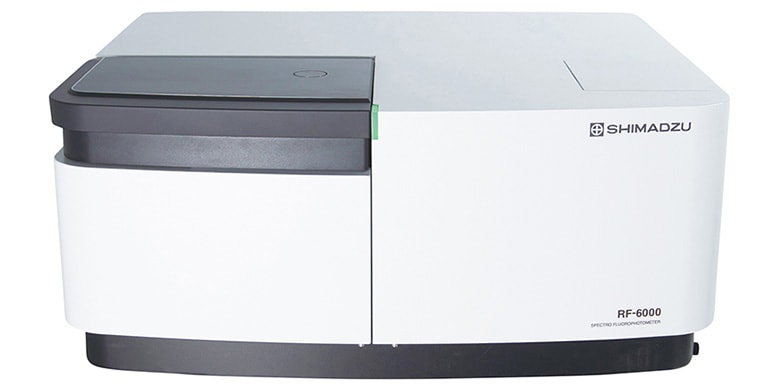
RF-6000


- Fluorescence properties can be confirmed quickly and easily while controlling the temperature with a thermoelectrically temperature-controlled single-cell holder. - Thermoelectric control can control temperatures in a wider range of temperatures (0 to 100 °C) than thermostatic water control.
The intensity and peak positions of fluorescence can vary depending on various external factors, such as temperature, solvent, and pH. Temperature is considered particularly important because it can affect the transition from an excited state to the ground state. Therefore, many experiments are conducted in low-temperature environments. (For an example of measuring data in a low-temperature state, refer to Application News No. A561.) Similarly, experiments are conducted in high-temperature states because fluorescent light measurements can also vary. (Peaks can shift or disappear.) This article describes an example of using a thermoelectric single-cell constant-temperature holder to measure temperature variations in the high-temperature direction.
June 26, 2025 GMT