Nexera UC


- Experimental polarity surface area (EPSA) can be measured using supercritical fluid chromatography (SFC). - EPSA can be measured in open access environment provided by Open Solution software.
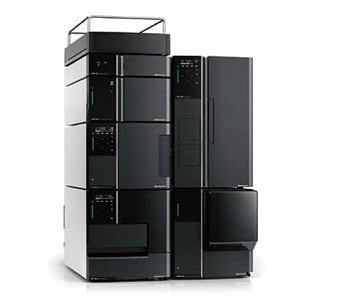
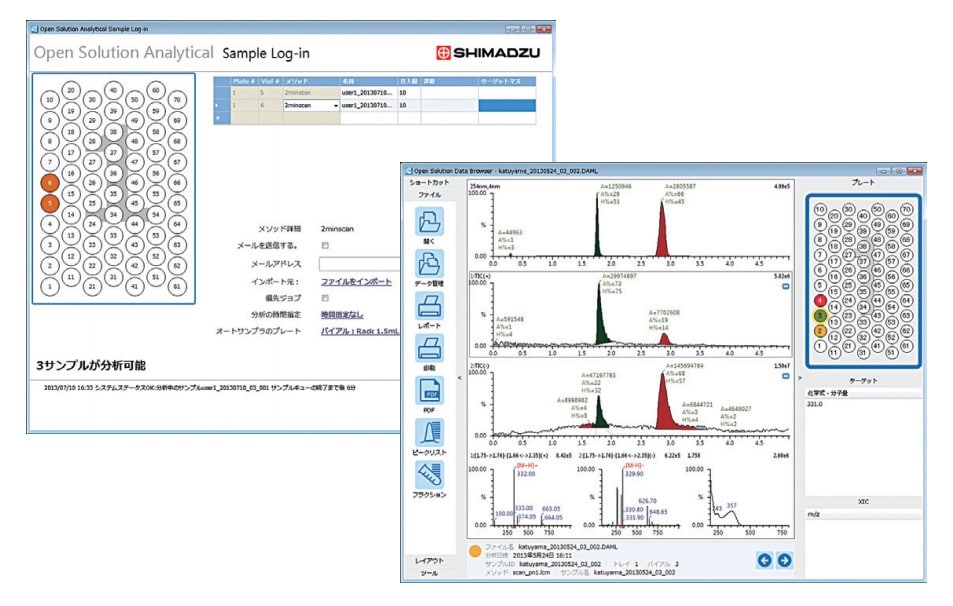
In new drug development, polarity of a drug is an important factor affecting its permeability to target sites. Polar surface area (PSA) represents the total exposed areas of polar parts on a surface of a molecule. Experimental data have demonstrated a strong positive correlation between PSA and membrane permeability. Previous studies suggested that molecules with PSA more than 140 Å2 tend to exhibit poor cell membrane permeability and oral bioavailability. Molecules that can cross the blood-brain barrier are generally required to have PSA of approximately 60–70 Å2. Furthermore, it has been verified that peptides with PSA more than 100 Å2 do not show significant passive permeability. PSA calculated based on the bonding patterns of atoms within a molecule is called topological polarized surface area (TPSA), which is used for predicting the physical properties of candidate compounds in the early stages of drug discovery. However, TPSA is calculated without considering the three-dimensional structure of the molecule. Therefore, TPSA may not accurately evaluate the total exposed polar surface area of the molecule where its steric structure changes due to intramolecular hydrogen bonding like a peptide, a middle-size molecule. On the other hand, EPSA is a measured value based on SFC retention time. Specifically, it is measured using a calibration curve created under analytical conditions where longer SFC retention times correlate with larger exposed polar area on the molecular surface. EPSA is considered effective even for molecular groups where accurate membrane permeability prediction is difficult using TPSA. In this paper, we present a case study in which we measured the EPSA of peptides using the Nexera UC supercritical fluid chromatograph, a photodiode array (PDA) detector, and the LCMS-2050 single quadrupole mass spectrometer. Furthermore, to measure the EPSA of large numbers of compounds synthesized during the drug discovery phase with high throughput, it is necessary to maintain the instrument in a state ready for analysis at all times and to establish an environment where reliable data can be obtained regardless of how the instrument was used by the previous operator. In the latter half of this paper, we introduce a workflow for high-efficiency EPSA measurement and the implementation of open access to the instrument using the open-access software Open Solution.
April 23, 2026 GMT