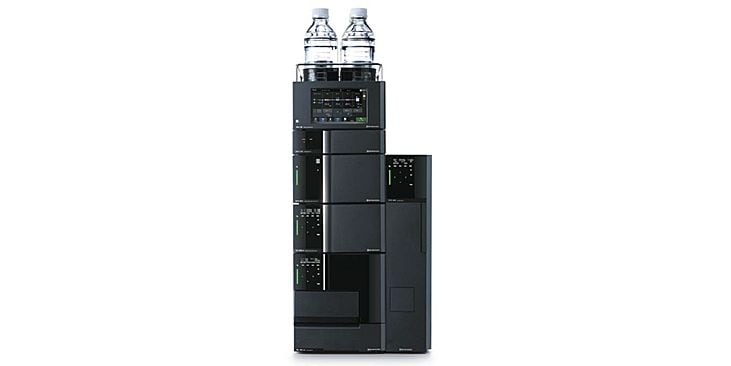

LCMS-TQ RX Series Triple Quadrupole LC-MS/MS


- Per- and polyfluoroalkyl substances (PFAS) in water samples containing insolubles can be analyzed in accordance with the newly developed PFAS analytical manual. - 30 different PFAS in environmental water, agricultural water, and other water samples containing insolubles can be measured with good recovery rates.
Because of their outstanding heat-resistance and waterrepelling properties, PFAS are used in a wide range of consumable products and industrial applications. While they confer useful properties, they also contaminate surface water, groundwater, soil, and air. Due to their potential negative effect on human health and other living organisms, there is a global trend toward more stringent regulations. Significant progress has been made in developing regulations and analytical methods for PFAS in drinking water, but these methods are not directly applicable to environmental water, agricultural water, and other water samples that contain large amounts of suspended solids. This is due to concerns such as the need to remove suspended solids and the potential decrease in recovery rates caused by these solids. The National Agriculture and Food Research Organization (NARO) recently developed a manual with a method for determining PFAS in water samples that contain insolubles. The method employs a sample preparation technique capable of efficiently extracting trace-level, multi-component PFAS from small-volume water samples containing various types of suspended solids. Simultaneous analysis of PFAS is performed by liquid chromatography tandem mass spectrometry (LC/MS/MS). This article describes the use of the LCMS-8060RX to analyze PFAS in a water sample that contained insolubles.
July 2, 2026 GMT
Some products may be updated to newer models