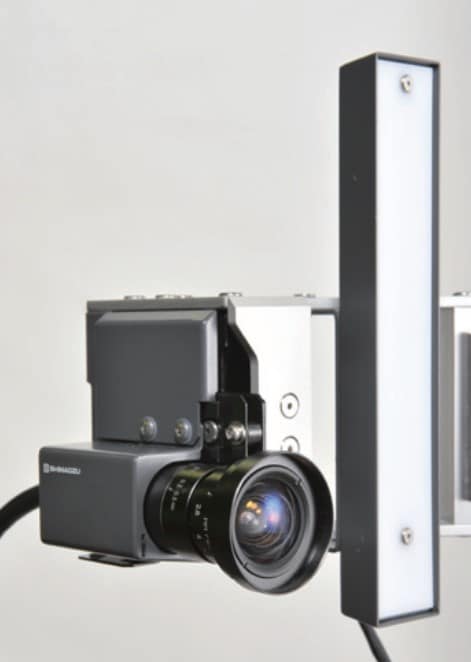
TRViewX


Material Testing System
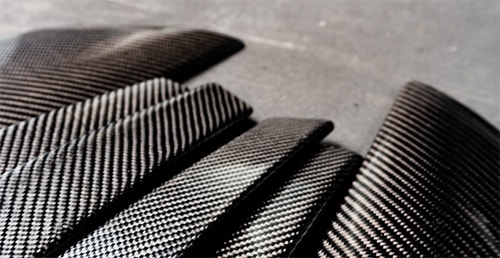
Carbon fiber reinforced plastic (CFRP) do not oxidize or rust and have a higher specific strength and stiffness than existing materials. Applications of CFRP are being investigated, with a focus on applications as industrial products that require strength and durability. Compared to existing homogeneous materials, composite materials like CFRP are anisotropic, and display complex failure behaviors as a result of tension, compression, bending, in-plane shear, out-of-plane shear, or a combination of these stresses arising from loading in the principal-axis direction. In recent years, use of CAE analysis in industry has become widespread since it can reduce numbers of prototypes and reduce the cost of new product development. Because values for each of the stress properties stated above are needed to increase precision when predicting product characteristics during product design, there is a strong demand for test methods able to evaluate pure failure behaviors in CFRP. This article describes an example of V-notched beam method (Iosipescu method, ASTM D5379) that is widely used as an in-plane shear test method for composite material specimens. The test method can apply load as a pure in-plane shear stress on the evaluation area by using a specimen cut with V-notches and supported at four asymmetrical points. Setting up the specimen and jig for this test method is relatively easy, and the test method can be used with a variety of CFRP laminate materials, including unidirectional materials, orthogonally laminated materials, and discontinuous fiber materials
August 26, 2016 GMT