


MultiNA II MCE-301, Microchip Electrophoresis System for DNA/RNA Analysis - Applications
Microchip Electrophoresis System

Most of the documents on the LITERATURE is available in PDF format. You will need Adobe Acrobat Reader to open and read PDF documents. If you do not already have Acrobat Reader, you can download it free at the Adobe's Website. Click the GET ADOBE READER icon on the left to download a free copy of Adobe Acrobat Reader.
Pharmaceuticals
mRNA Drug Manufacturing Processes
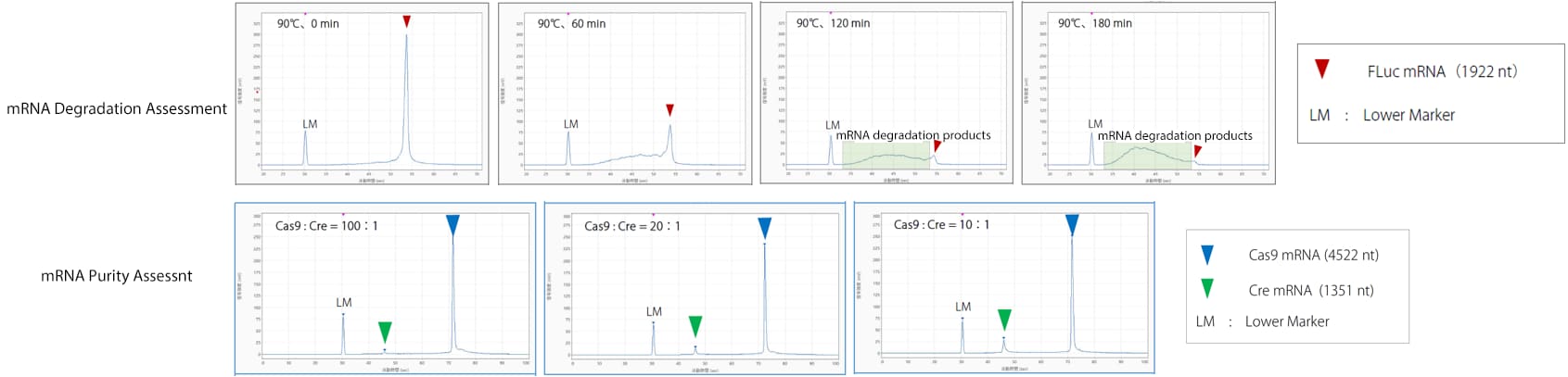
mRNA drugs treat or prevent disease by introducing artificially synthesized mRNA encoding the genetic information of a specific protein into the body, where it directs the production of that protein in the cytoplasm. These drugs are manufactured through a series of steps, including RNA synthesis via DNA transcription, addition of a cap structure, mRNA purification, and encapsulation into lipid nanoparticles (LNPs). Because MultiNA II enables assessment of mRNA degradation and purity during the purification process, as well as analysis of mRNA encapsulated in LNPs, it holds promise for quality control applications in mRNA drug manufacturing.
Related Applications
Life Sciences
Next-Generation Sequencing (NGS)
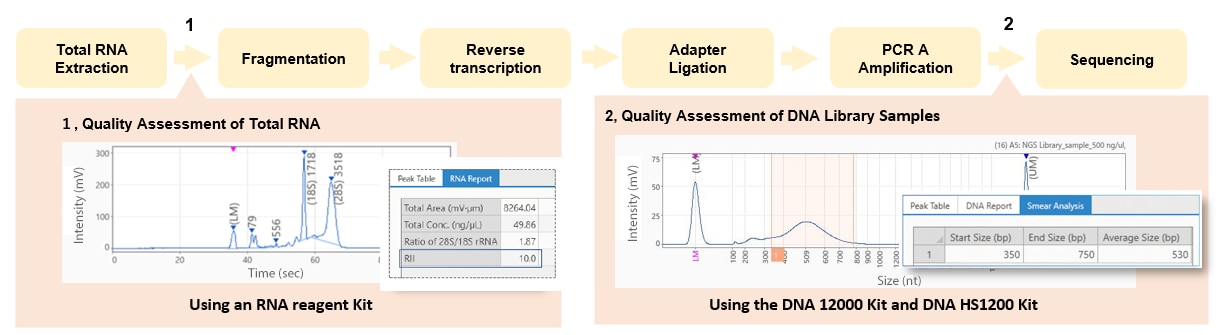
Next-generation sequencers analyze large volumes of DNA and RNA sequences with high speed and accuracy, making them widely used in genetic research and disease elucidation. Total RNA extracted from biological samples serves as the fundamental input material for sequencing. Obtaining high-quality sequencing results requires evaluating the quality of extracted Total RNA and understanding the size distribution and concentration of the NGS library. MultiNA II calculates the RNA Integrity Index (RII) for Total RNA and provides size distribution information through its smear analysis function.
NGS (RNA-Seq) Workflow
Related Applications
Genome Editing
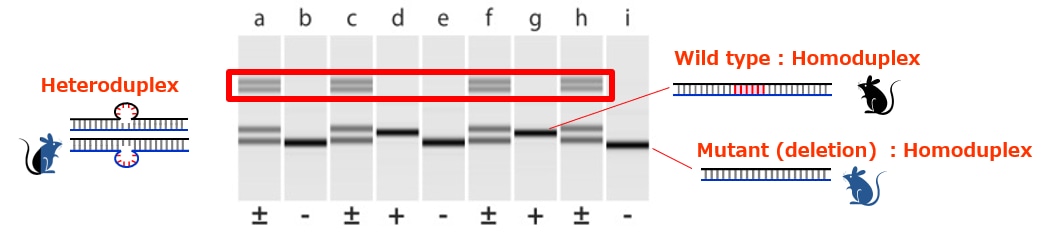
Advances in genome editing technology, which enable the introduction of arbitrary sequences into target genes, have driven research toward practical applications across diverse fields, including pharmaceuticals, food, and microbial chemical synthesis. Evaluations of mutations at target sites can be performed by sequencing DNA or by using enzymes that recognize and cleave mismatches in double-stranded DNA; however, both methods require considerable cost and effort. Heteroduplex mobility analysis (HMA) is an electrophoresis method that exploits differences in mobility arising from three-dimensional structure. Heteroduplex DNA differs in three-dimensional structure from homoduplex DNA, resulting in different electrophoretic mobility. As a result, HMA enables simple and cost-effective detection of mutations.
Detection of Heteroduplex DNA by HMA
Related Applications
Clinical Settings
Infection control is critical for preventing the spread of healthcare-associated bacterial infections. Molecular epidemiological analysis of bacterial strains is essential for identifying transmission routes and implementing appropriate countermeasures. PCR-based ORF Typing(POT), developed by Dr. Masahiro Suzuki of Fujita Health University, is a method that amplifies multiple bacterial genes by multiplex PCR, performs electrophoresis, and compares homology between strains based on POT values calculated from the resulting band patterns. By enabling tracking of a single bacterial strain, POT provides valuable information for infection control and has been applied to the management of healthcare-associated infections.
Food
In 1963, the Food and Agriculture Organization of the United Nations (FAO) and the World Health Organization (WHO) established the Codex Alimentarius Commission to protect consumer health and ensure fair practices in international food trade. The Codex Alimentarius Commission develops international food standards and guidelines, including those for food labeling, which serve as a reference for food labeling regulations in many countries. National food labeling systems require declarations of information such as ingredients, additives, allergens, and country of origin.
Species Identification
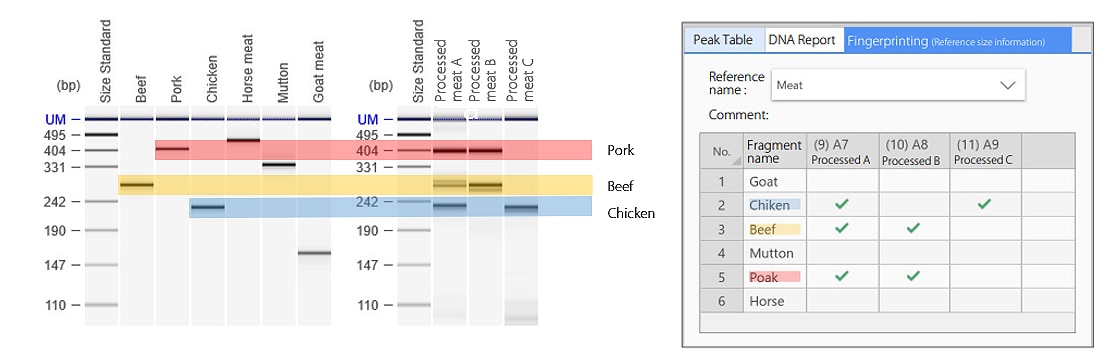
By amplifying DNA extracted from food by PCR and running the PCR products on MultiNA II, gene-based species identification can be achieved. By using the fingerprinting analysis function of MultiNA II, the presence or absence of bands at target sizes can be determined automatically.
Automated Meat Species Identification by Fingerprinting Analysis
Related Applications
Allergen Testing in Food
The Codex standard for the labeling of prepackaged foods (CODEX STAN 1-1985) sets requirements for allergen labeling. Identifying allergen-specific genes enables determination of whether a given ingredient has been used.
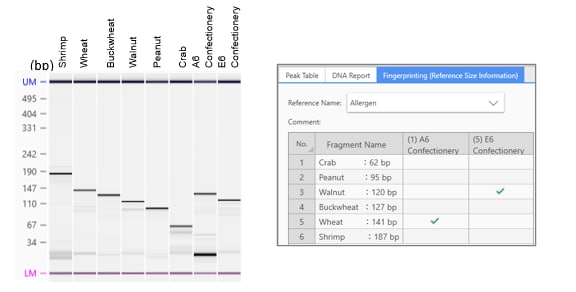
Gel Image and Fingerprinting Analysis of Representative Allergenic Foods
Related Applications
Environment
Ecological and Environmental Assessment
Ecological and environmental assessment technologies are essential for estimating the distribution and composition of organisms in water and soil, as well as for evaluating biodiversity and ecosystems. In recent years, ecological surveys (monitoring) using environmental DNA (eDNA) have attracted attention as a rapid and convenient alternative to conventional field surveys. The use of microchip electrophoresis to confirm PCR-amplified microbial DNA collected from environmental water samples, such as from rivers and lakes, through band pattern analysis is currently being explored.