


Theoretical Plate Number and Symmetry Factor
A theoretical plate is a hypothetical zone in a chromatographic column where equilibrium occurs between the mobile and stationary phases. Theoretical plate number (N) is an index that indicates column efficiency. The concept was developed by Martin and Synge in 1941, adapting plate theory from fractional distillation to chromatography. The larger the theoretical plate number, the sharper the peaks and the more efficient the separation.
"Theoretical plate number" and "symmetry factor" are important indexes that describe column performance. This article talks about these two indexes.
What is Theoretical Plate Number (N)?
Theoretical plate number (N) is an index that indicates column efficiency. It describes the number of plates as defined according to plate theory, and can be used to determine column efficiency based on calculation in which the larger the theoretical plate number the sharper the peaks. The theoretical plate number is included as a numerical value in column instruction manuals and inspection reports.
Calculating Theoretical Plate Number
Basic Formula
Assuming a Gaussian distribution (normal distribution), the theoretical plate number is represented by equation (1).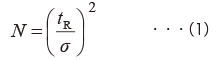
Where:
tR = retention time
σ = standard deviation
Alternative Calculation Methods
As shown in Fig. 1, assuming a Gaussian distribution, the peak width W is 4 σ and peak FWHM W0.5h is 2.354 σ. Substituting these values into equation (1) gives equations (2) and (3).
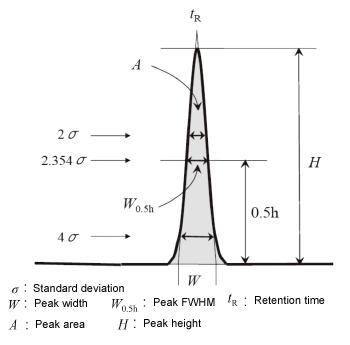
Fig. 1
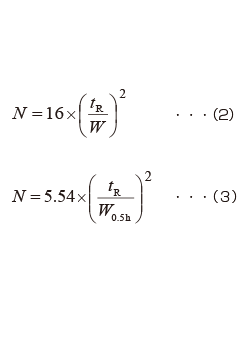
(Left) Alt tag: Gaussian peak diagram showing width measurements W and W0.5h
(Right) Alt tag: Alternative N calculation formulas using peak width and FWHM
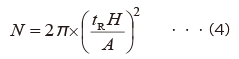
The theoretical plate number can also be represented in terms of peak area A and peak heightHas shown in equation (4).
Height Equivalent to a Theoretical Plate (HETP)
The height equivalent to a theoretical plate (HETP or H) is another measure of column efficiency. It represents the length of column required for one theoretical plate to occur. Relationship between N and HETP:
H = L / N
Where:
H = Height equivalent to a theoretical plate (HETP)
L = Total column length
N = Number of theoretical plates
A lower HETP value indicates higher column efficiency, as more theoretical plates fit within the same column length. This inverse relationship means that improving efficiency requires either increasing N or decreasing H.
Importance in Chromatography
Theoretical plate number is a critical parameter for evaluating and optimizing chromatographic separations:
Column Selection: Higher plate numbers indicate better separation capability for complex mixtures
Method Development: N values guide optimization of mobile phase composition, flow rate, and temperature
Quality Control: Monitoring N over time helps detect column degradation
Peak Sharpness: More theoretical plates result in narrower, sharper peaks with better resolution
For a given column, the greater the number of theoretical plates, the greater is the number of ideal equilibrium stages in the system and the more efficient is the separation.
Explore Shimadzu HPLC Columns
Compare our full lineup of high-efficiency chromatography columns designed for maximum theoretical plate performance.
Symmetry Factor
Symmetry factor (S, also called "tailing factor") is a coefficient that shows the degree of peak symmetry. It is represented in equation (5) based on the measurements shown in Fig. 2.
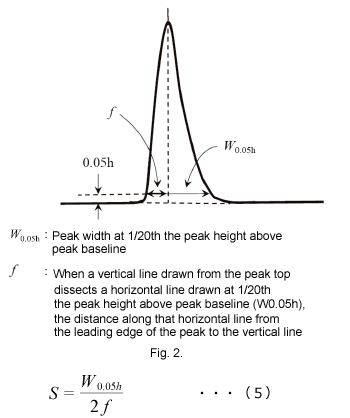
S>1: Tailing peak
S=1: Peak with Gaussian distribution (symmetry)
S<1: Leading peak
Caution is required since both the theoretical plate number and symmetry factor can change depending on the type of analysis and analytical conditions used.
References:
1) JIS K0124:2011 General rules for high performance liquid chromatography
2) JIS K0214:2013 Technical terms for analytical chemistry (Chromatography part)
FAQ
What does a higher theoretical plate number mean?
A higher theoretical plate number (N) indicates better column efficiency. More theoretical plates mean more equilibration stages between the mobile and stationary phases, resulting in sharper peaks and improved separation of sample components.
What is the difference between N and HETP?
N (theoretical plate number) counts the total number of theoretical plates in a column, while HETP (height equivalent to a theoretical plate) measures the column length required for one plate. They are inversely related: H = L / N, where L is column length.
What is a good number of theoretical plates?
A good theoretical plate number depends on your application:
Routine analysis: 5,000-10,000 plates is sufficient for most quality control applications Complex mixtures: 15,000-30,000 plates for pharmaceutical impurity testing or environmental samples
High-resolution work: 50,000+ plates for research-grade separations Shimadzu offers columns optimized for each efficiency level:
For ultra-high resolution research, combine Shimadzu Nexera UHPLC systems with sub-2µm particle columns to achieve 50,000+ theoretical plates, enabling separation of complex biological samples and metabolomics studies.