
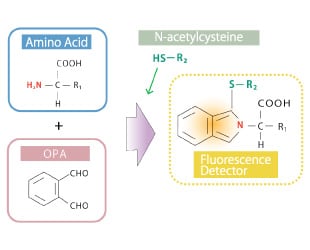
Selectively detects amino acids based on Shimadzu's highly acclaimed post-column reaction technology and high-sensitivity fluorescence detector.


Nexera Post-column Amino Acid Analysis System
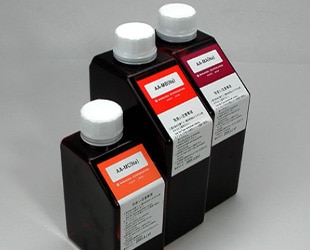
Amino acid analysis occupies an important role in diverse fields, such as food science and pharmaceutical manufacturing. The Nexera Amino Acid Analysis System uses detection by post-column fluorescence derivatization, with o-phthalaldehyde (OPA)/N-acetylcysteine as the reaction reagents, to selectively and sensitively quantitate the amino acids contained in samples have the complex matrix.
Amino acid analysis is applied to the elucidation of peptide and protein structure. As amino acids are essential nutrients that comprise the proteins in the human body, the amino acid analysisis particularly useful for detecting imbalances, deficiencies and metabolic conditions. Amino acid analysis is frequently utilized to identify conditions like aminoaciduria – an inborn error of amino acid metabolism – and urea cycle defects. Key to investigating several inherited metabolic diseases, particularly those involving unexplained seizures, amino acid tests of the cerebrospinal fluid (CSF), blood and/or urine are incredibly useful diagnostic tools. Further to this, the high sensitivity afforded by amino acid analysis makes it invaluable in the fields of food science and pharmaceuticals, where the capabilities are used to manage quality control in the production of food and drugs.
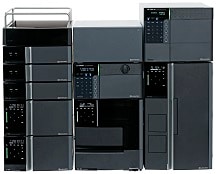
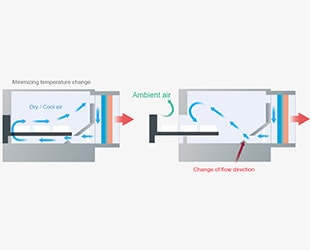
The process of amino acid analysis involves hydrolyzing the peptide bonds before the analysis. Shimadzu’s Nexera Amino Acid Analysis system is designed to deliver precise quantification of amino acids in complex samples and integrates high-performance liquid chromatography (HPLC) and specialized consumables. The instruments selectively detect amino acids based on Shimadzu’s acclaimed post-column reaction technology and high-sensitivity fluorescence detectors. The instruments also boast superb injection precision over a wide range of volumes and a unique design that ensures reliable sample cooling.
Recommended Reading: AI, Automation, and the Future of Drug Discovery Description
In this Drug Discovery News interview, Raymond Wong of Shimadzu UK shares insights into how AI-enabled workflows, connected data, and laboratory automation are helping accelerate pharmaceutical research and development.
Shimadzu has released the Nexera X4 Ultra High Performance Liquid Chromatograph.
Expanding on technologies cultivated with previous Nexera series models, the next-generation Nexera X4 ultra high performance liquid chromatograph (UHPLC) achieves an incomparable level of analytical performance. The lowest degree of peak broadening* in the industry results in ultra-sharp peaks and outstanding separation performance while cutting-edge fluid control technology provides exceptional solvent delivery consistency, even for fast analysis under ultra-high-pressure conditions, and highly reliable results. Engineered with precision, the high-end Nexera X4 UHPLC offers new value for all laboratories that demand maximum performance.
Nexera IC Ion Chromatograph has been released.
The Nexera IC ion chromatograph combines a compact footprint with uncompromising performance, enabling anyone to perform analysis effortlessly and efficiently.
PL-40, Automation-Compatible Plate Loader for LC/LC-MS Systems has been released
The PL-40 solves for LC/LC-MS automation, it seamlessly loads plates of pretreated samples into an LC/LC-MS system, enabling a fully automated workflow, from pretreatment to analysis.
New Technical Report is available, Optimization of Supercritical Fluid Extraction Parameters for Vitamins D2, D3, and K1 from Pharmaceutical Preparations
New Technical Report is available, Optimization of Supercritical Fluid Extraction Parameters for Vitamins D2, D3, and K1 from Pharmaceutical Preparations
New Tips & Tricks is available, Automated Dilution and Preparation of Standard and Sample Solutions for Analysis

2 Zero hunger

3 Good health and well-being