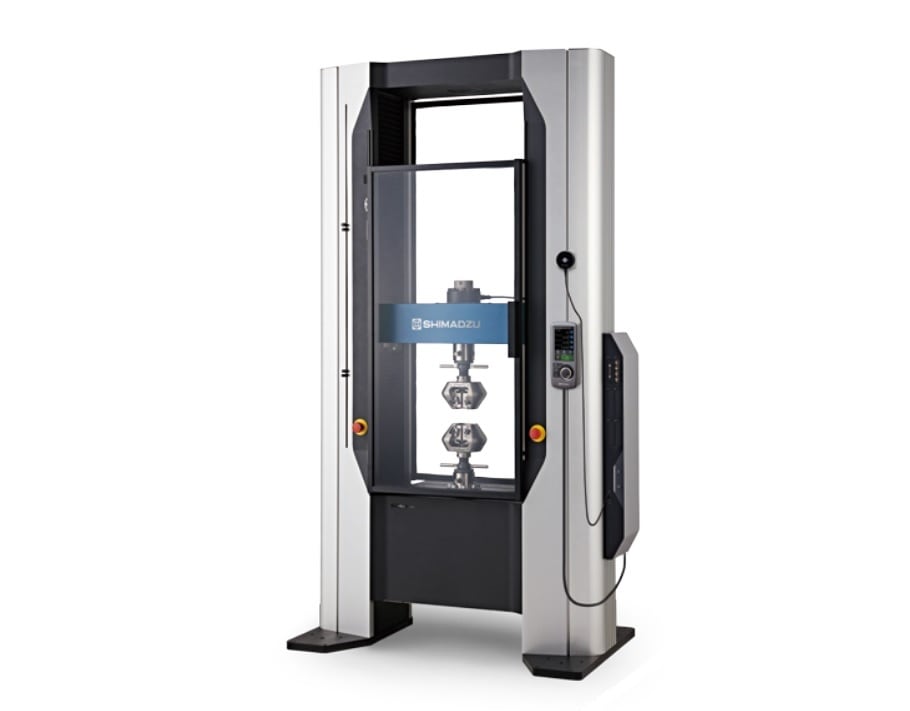

AUTOGRAPH AGS-V Series


Material Testing System
Carbon fiber reinforced plastic (CFRP) has a higher specific strength and rigidity than metals, and is used in aeronautics and astronautics to improve fuel consumption by reducing weight. However, CFRP only exhibits these superior properties in the direction of its fibers, and is not as strong perpendicular to its fibers or between its laminate layers. When force is applied to a CFRP laminate board, there is a possibility that delamination and matrix cracking will occur parallel to its fibers. Furthermore, CFRP is not particularly ductile, and is known to be susceptible to impacts. When a CFRP laminate board receives an impact load, it can result in internal matrix cracking and delamination that is not apparent on the material surface. There are many situations in which CFRP materials may sustain an impact load, such as if a tool being dropped onto a CFRP aircraft wing, or small stones hitting the a CFRP wing during landing. Consequently, tests are required for these scenarios. One of these tests is compression after impact (CAI) testing. CAI testing involves subjecting a specimen to a prescribed impact load, checking the state of damage to the specimen by a nondestructive method, and then performing compression testing of that specimen. This article describes CAI testing performed according to the ASTM D7137 (JIS K 7089) standard test method.
September 6, 2016 GMT
Some products may be updated to newer models