


1. What Is a Protein Sequencer?
- 1. What Is a Protein Sequencer?
- 2. Differences from Mass Spectrometry-Based Amino Acid Sequence Analysis
- 3. Example of a Complete Peptide Sequence Analysis Using Complementary Application of ISD and the PPSQ Protein Sequencer
-
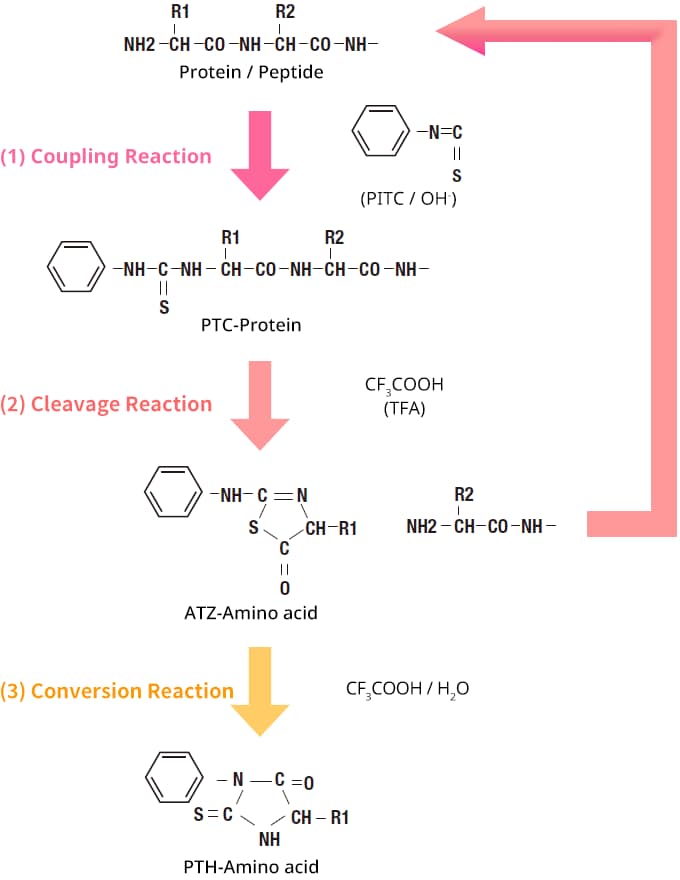
A protein sequencer automates Edman degradation, a method developed by Pehr Victor Edman in 1950. The reaction scheme is as follows.(1) Coupling Reaction
Under basic conditions, phenyl isothiocyanate (PITC) is coupled to the N-terminal amino group of the isolated and purified sample protein (including peptides).
(2) Cleavage Reaction
Under acidic conditions, the PITC-coupled N-terminal amino acid is cleaved and extracted into the organic phase as an anilinothiazolinone (ATZ) derivative.
(3) Conversion Reaction
The organic solvent is evaporated, and the extracted ATZ derivative is converted in acidic aqueous solution to a stable derivative known as a phenylthiohydantoin (PTH) amino acid.
-
-
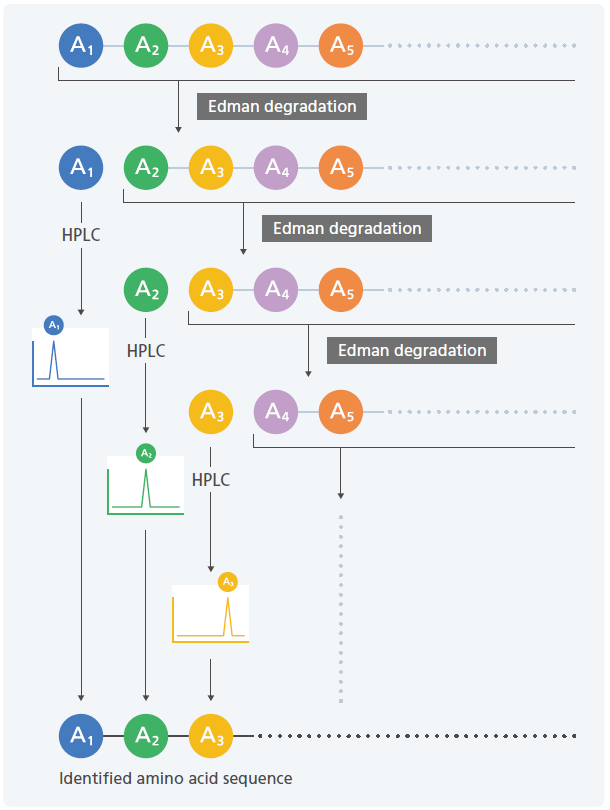
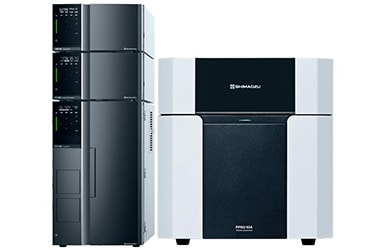
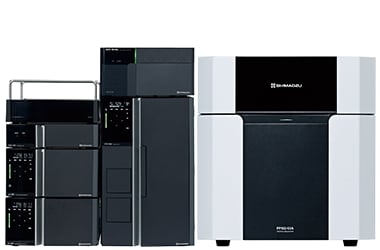
The PPSQ-50 Series system determines the amino acid sequence by sequentially cleaving amino acids, such as PTH-amino acids, from the N-terminus of a protein via Edman degradation and analyzing them by HPLC.
As shown in the figure on the right, one complete sequence of steps—from Edman degradation to PTH-amino acid analysis by HPLC—constitutes one cycle. By repeating this cycle and assembling the resulting PTH-amino acids in order, the N-terminal amino acid sequence of a protein or peptide can be accurately and reliably determined. The amino acid sequence of proteins not registered in any database can also be determined. Applications extend beyond basic research to include the analysis of antibody-based therapeutics, as well as proteins and peptides in food products, among many others. -
Application Example of the Protein Sequencer
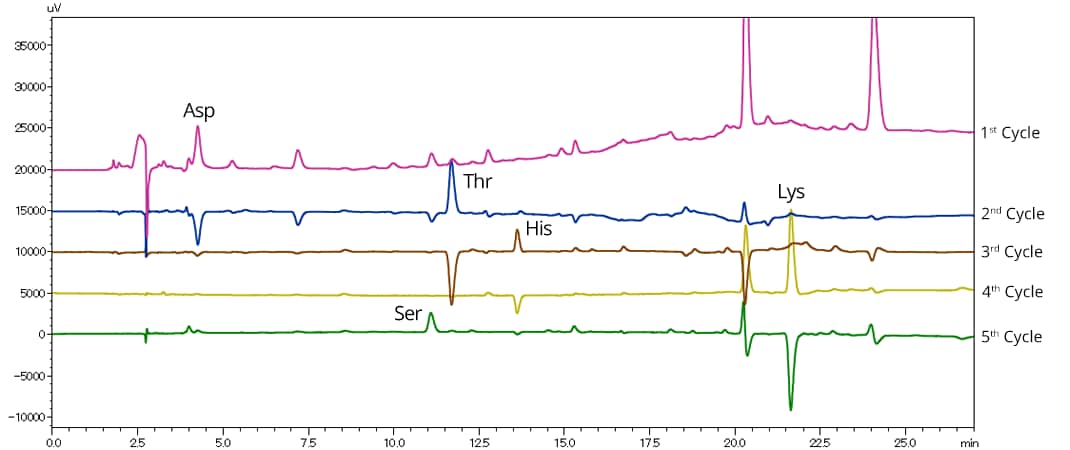
Shown here is an example of amino acid sequence analysis of 10 pmol of commercially available Bovine serum albumin. The chromatograms are displayed from top to bottom, beginning with cycle 1 of the Edman degradation, followed by cycle 2. In cycle 1, one amino acid derivative was detected in addition to byproducts generated by Edman degradation. The residue was identified as aspartic acid.
From cycle 2 onward, by using the subtracted chromatograph, a specific amino acid derivative was easily detected.
Assembling these residues in order yields the N-terminal amino acid sequence of this protein: Asp-Thr-His-Lys-Ser…
Asp-Thr-His-Lys-Ser-Glu-Ile-Ala-His-Arg-Lys-・・・・・
Features of the Protein Sequencer
The following features make the protein sequencer an indispensable instrument for both basic research and for applications requiring a high degree of reliability, such as quality control of protein-based pharmaceuticals.
- Delivers highly reliable sequence determination, enabling unambiguous amino acid sequencing
- Enables direct analysis of intact proteins without additional processing
- Distinguishes Ile and Leu, which share identical molecular masses
- Determines the presence and position of disulfide (S–S) bonds
- Extremely easy to operate