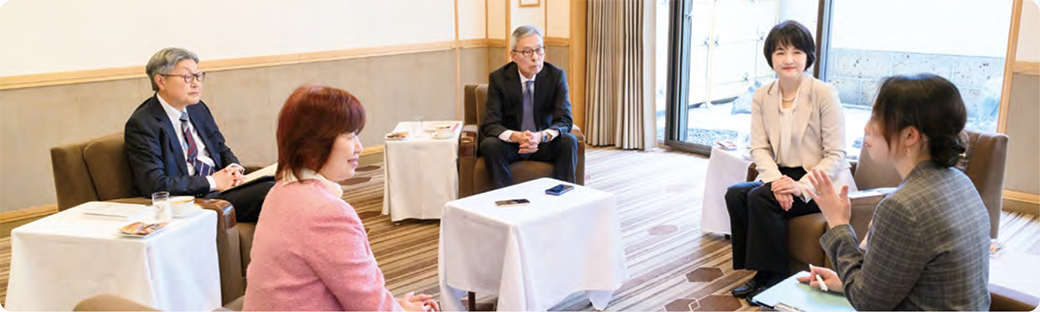


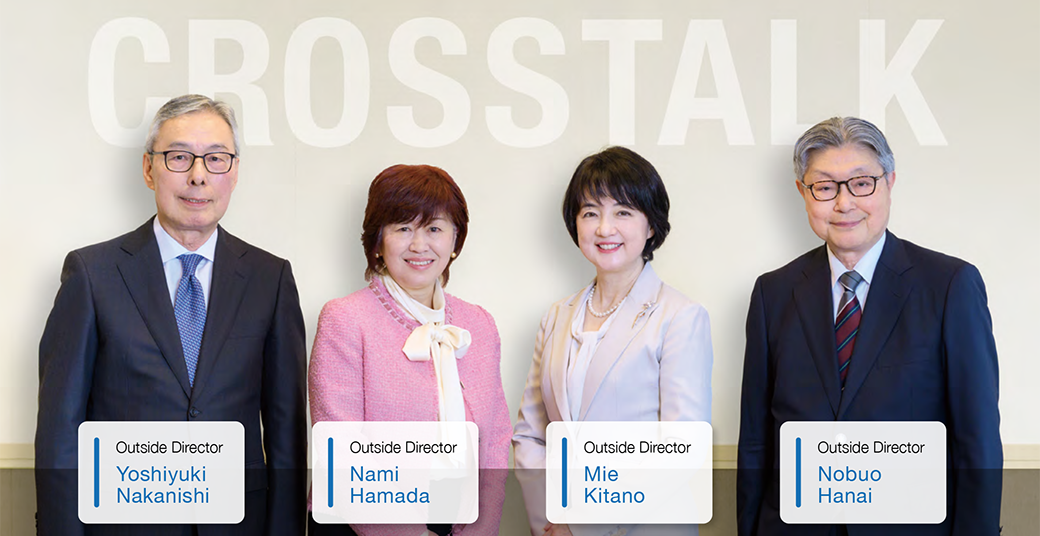
In 2025, the Company marked the 150th anniversary of its founding. As its vision for 2035, the Company aims to become a company that creates social value across four customer domains through the Pursuit of Planetary Health. In this discussion, participants exchanged views on topics including the Company’s current situation and their expectations for the new Medium-Term Management Plan aimed at realizing this vision.
| Hagihara |
In 2025, Shimadzu Corporation marked the significant milestone of the 150th anniversary of its founding. As outside directors, you also took part in various events. Looking back over the past year, was there anything that made you see Shimadzu in a new light?
 |
|
| Kitano | The events reaffirmed for me Shimadzu Corporation’s commitment to continuous self-reinvention over its 150-year history, as well as the strength of its underlying Corporate Philosophy of “Contributing to Society through Science and Technology.” In 2025, I was particularly impressed that this philosophy bore fruit in the form of the world’s first mass spectrometric analysis technology for microplastics, delivering sustainability outcomes directly linked to improving the safety of food, water, and the environment. I strongly felt that applying Shimadzu’s accumulated technologies to solving future social challenges is precisely the responsibility we must fulfill as we look toward the next 150 years. | |
| Hamada | The data show that diversity, particularly the advancement of women in the workplace, remains a work in progress. However, at the exhibition in September 2025, it was impressive and very encouraging to see many female employees playing prominent roles at the Shimadzu booth. I also think Shimadzu has made significant progress in enhancing value through “instruments plus digital technologies,” including software that uses AI to compensate for differences in the skill levels of instrument users. | |
| Hanai | Compared with companies based in Tokyo, I feel that Shimadzu has unique strengths rooted in what it has preserved over time. When I first became an outside director, I thought there were many things that needed to be transformed, but I came to realize that firmly maintaining the core principles that should be preserved has, in a positive sense, become the foundation of the Company’s culture. At the same time, the challenge going forward will be how to accelerate transformation amid global competition while preserving those strengths. | |
| Nakanishi |
At the 150th anniversary commemorative events, many representatives from overseas partner companies also participated, and I felt that the globalization of Shimadzu’s network is steadily progressing. I believe the challenge going forward will be to deepen the substance of the Group’s global integration. Also, as Mr. Hanai noted, with a history built over 150 years, I believe there are aspects that cannot be changed so easily. Recently, however, as seen in large-scale M&A, the establishment of the R&D Center in North America and the India plant, and the creation of the Sales & Marketing Division and the Manufacturing Division, I have the impression that management has become more growth-oriented. The true value of these initiatives will be tested from this point forward, and what matters now is how far they can be turned into tangible results.
 |
|
| Hagihara | I believe the discussions among the outside directors have also helped encourage the Company to shift toward a more proactive stance. To be frank, does the Board of Directors provide an environment that encourages open discussion? Also, do you feel that executive management properly considers the opinions of the outside directors and puts them into action? | |
| Hamada | The Board of Directors provides an environment in which members can speak freely, and discussions are very active. Dissenting opinions are expressed, and votes against proposals are cast, so I believe the Board functions in a very healthy manner. While Shimadzu has strengths in what remains unchanged, I believe the world is now undergoing a once-in-a-century transformation, driven by factors such as AI, geopolitical risks, and trade tensions. Over the next several years, I think we may see enormous changes. That is why we need to think more deeply about what to preserve and what to change. One such area that needs to change, in my view, is improving capital efficiency. This does not mean that Shimadzu’s current capital efficiency is low among companies listed on the Prime Market of the Tokyo Stock Exchange, but compared with U.S. competitors, it still lags behind. I believe we must continue to pursue further improvements in capital efficiency. This is a topic we have already discussed extensively, but I would like to explore it in even greater depth. |
|
| Nakanishi | I also think there could be more high-level discussion on topics such as how to generate greater profits with limited capital. Shimadzu’s Board of Directors materials are highly detailed, and as a result, discussions tend to focus on the details. I believe the Board of Directors’ essential role is to discuss the Company’s direction from a broader, more strategic perspective and set a clear strategic direction. To that end, I think it would be desirable to allocate more time to discussion and further enhance opportunities for exchanging opinions. | |
| Hanai | From another perspective, the Board of Directors is functioning effectively, and the prior briefings are also thorough. As outside directors, we participate in Board discussions after receiving sufficient information in advance. However, even after spending considerable time on discussions, there are some areas where it is sometimes difficult to see how matters progress afterward. Because outside directors do not attend Executive Committees, I feel it would be helpful to have greater visibility into the discussions and reviews that subsequently take place within executive management and into how those matters are ultimately implemented. | |
| Hamada |
When we express our opinions freely and actively at Board meetings, executive or corporate officers sometimes say that they will review the matter later or take it back for consideration, but I would like to receive more feedback afterward. Of course, it is not simply a matter of saying, “We will do this because the Board said so.” Naturally, each business division has its own views, and I think a response such as “we have a different view on this matter” is also valid.
 |
|
| Hanai | We would like to communicate more with executive management, but as Ms. Hamada said, communication does not always become truly two-way. Feedback could be provided afterward, and we would also like to engage in active discussions at Board meetings. | |
| Kitano | I recognize that over the past year, the Board of Directors has evolved significantly from a forum centered on reporting to one that deepens decision-making through discussion. Going forward, I believe it will be important to establish a cycle for verifying whether the content of discussions is appropriately reflected in initiatives and outcomes, and for holding further discussions as necessary. | |
| Hagihara | A new three-year Medium-Term Management Plan will begin in FY2026. It was also discussed at length by the Board of Directors. Please tell us what you see as the plan’s strengths and what challenges you see in achieving it. | |
| Hanai | We discussed the new Medium-Term Management Plan on many occasions. I believe we can expect the speed of new product development, particularly in the Analytical & Measuring Instruments Business, to increase and lead to improved earnings. We also had repeated discussions on the recurring revenue business to further increase earnings, and this was clearly reflected in the Medium-Term Management Plan materials. That said, I now feel that it might have been better to include more on business strategy. For example, the Analytical & Measuring Instruments Business has a diverse product lineup across various domains, but continued strategic discussion is needed on matters such as whether this is truly sufficient to compete successfully on a global basis, or whether we should narrow our focus to areas where we have greater strengths. | |
| Hamada | I share the same view of the issue. The Board of Directors engages in high-level discussions, while implementation is entrusted to executive management. While reviewing the draft Medium-Term Management Plan, I feel that we were not able to deepen discussions on how the strategies would be implemented. For example, the Company opened an R&D Center to strengthen its position in the North American market, but achieving results in the short term in a market that is the home market of major competitors will not be easy. That is why it is important to discuss matters from a backcasting perspective anchored in a 10-year view and to translate them into specific milestones, such as “we would consider it a success if we can reach this point in five years.” I believe we need to revisit this point. | |
| Hagihara | You have just said that it is important to look 10 years ahead and use backcasting to identify current and medium-term challenges. What are your thoughts on the ability to formulate a long-term vision? | |
| Hamada | Shimadzu has traditionally competed through technology, and everyone naturally takes pride in that, which is a wonderful thing. However, we are now in an era in which it is difficult to win on product capabilities alone. Our competitors are larger than we are, so naturally they have more people engaged in R&D and a significantly different level of investment. I would like us to have more strategic discussions on the point raised by Mr. Hanai: which fields we should choose to compete in. | |
| Nakanishi | Medium-Term Management Plans inevitably tend to become somewhat overly broad and insufficiently focused. In hindsight, at the initial stage of concept development, the outside directors could have stepped in more and offered clearer proposals on what the Medium-Term Management Plan should look like. I believe a key theme going forward will be to discuss the future vision with a diverse group of members, including younger employees, and translate it into a well-prioritized strategy. | |
| Hagihara | Please tell us what you expect from the new Medium-Term Management Plan. | |
| Nakanishi | The recurring revenue business is one area I particularly expect to see progress in. Equipment manufacturers tend to prioritize equipment sales over maintenance and services, but the recurring revenue business is highly profitable and extremely important for strengthening the Company’s overall earning power. In that sense, I believe another key point will be to transform the organizational mindset and culture often found at equipment manufacturers. | |
| Kitano |
Overseas expansion is an important pillar supporting future growth, and given the high overseas sales ratio, I believe that continued business expansion in overseas markets is essential. To achieve this, the development of global talent is extremely important. I saw Shimadzu’s underlying strength on NHK’s program Makaizo no Yoru last year. Shimadzu Corporation’s underlying strength in bringing together its capabilities and creating results when facing challenges was impressive. Under the Medium-Term Management Plan as well, I expect the organization to evolve by strengthening cross-functional collaboration, including overseas sites, and becoming one that can address common challenges through discussion and swift execution.
 |
|
| Hamada | Even with a major strategy in place, what ultimately matters is the ability to execute. In reviewing the Medium-Term Management Plan, we saw many achievements, but also identified areas where objectives were not achieved. These include challenges related to organizational climate and decision-making processes. For Shimadzu to prevail over its competitors, I believe future transformation will be needed to enable the Company to move more quickly, including further changes in organizational design and culture, such as greater delegation of authority to overseas operations. | |
| Nakanishi | For companies with long histories, reforming organizational culture is never easy. It is not necessary to change everything, but it is important to identify what should be changed and for top management to communicate the message consistently and repeatedly. It is difficult to achieve transformation through front-line initiatives alone, and I believe that commitment from top management and persistent follow-through are key. | |
| Hanai |
M&A can also be an effective means of transforming organizational culture and corporate culture. There are also things we should learn from acquired companies. By learning from the strengths of acquired companies and incorporating them into our own culture, we can bring fresh perspectives into the organization. Tescan, which Shimadzu plans to acquire, is a sizable company, and there should be many things that Shimadzu can learn from it. In a sense, this may also be one of the purposes of M&A.
 |
|
| Nakanishi | The point Mr. Hanai made is extremely important. If we try to absorb everything simply because a company has become a subsidiary, it will create friction. Simply saying that we should learn from the strengths of subsidiaries will not be enough to make it take root, so a genuine and thoughtful approach is required. | |
| Kitano | M&A may be one catalyst, but securing and leveraging global talent is also important. I believe it is essential to create a culture that welcomes external talent and enables them to fully realize their potential. In addition, I believe it will be important going forward to establish mechanisms that enable many employees to fully contribute and help execute the AI strategy. | |
| Hamada | From a different perspective, I feel a sense of urgency about the reality that job switching and employee turnover among younger employees are accelerating at Tokyo-based companies. Many companies in Tokyo are seeing that if they do not transform themselves, it will affect recruitment, and the capable talent they have worked hard to develop will leave for other opportunities. Shimadzu recruits strong talent, and most of them build long-term careers at Shimadzu, but as Japan’s population declines, this wave of increased talent mobility cannot be avoided. I believe we need the awareness and sense of urgency to change before that wave arrives. | |
| Hagihara | Finally, please share your messages for shareholders and investors. | |
| Hanai | I can say with confidence that Shimadzu Corporation is a strong company with high standards in many respects, including technological capabilities, a solid financial foundation, corporate culture, and the quality of its talent. There are some challenges, such as the appointment of global talent to key roles, but it is an outstanding company. Feedback from investor meetings has reminded me of the importance of the role of outside directors in viewing the Company objectively and critically. We frankly communicate not only the Company’s strengths but also its challenges, and provide appropriate recommendations and oversight from an independent standpoint. I would like shareholders to know that Shimadzu is a company where such a process is firmly in place. | |
| Kitano | Through the Sustainability Management Briefing, we had opportunities to engage in dialogue with many investors. I feel that expectations for technology development are very high, and going forward, I would also like us to proactively communicate our initiatives in non-financial areas, such as human capital strategy and risk management. | |
| Nakanishi | Shimadzu has been highly rated in various sustainability-related rankings, including the Nikkei SDGs Management Grand Prize, and it is also a company that commands strong trust in its technological capabilities, as exemplified by Koichi Tanaka’s receipt of the Nobel Prize. I believe it is important not to rest on those expectations, but to maintain a stance of always aiming to deliver results that exceed expectations. | |
| Hamada | I would like investors to provide candid feedback not only from the perspective of Shimadzu as a Japanese company, but also in comparison with global competitors. Among Japanese companies, Shimadzu may have been viewed in some respects as a comparatively stable company. However, Shimadzu’s competitors are U.S. companies that are larger than Shimadzu. I would like investors to take a rigorous and long-term view of how Shimadzu intends to compete in that market. Outside directors and investors are, in that sense, partners. To make the Company even better, I would like investors to actively provide feedback. | |
| Hagihara | As an employee, I would also like to turn the valuable insights from today’s discussion into concrete action. Thank you very much. |